
Author: Nitin N. Varia
Date published: August 20, 2025
This blog is inspired by Sri Aurobindo’s Third Dream as described in his Fifteenth August 1947 message, Five Dreams’, especially the idea of the movement towards a deeper Human Unity.
Sri Aurobindo’s vision cannot, in my view, be confined to the political events of one country or one particular period. His Five Dreams were a vision of humanity’s evolutionary journey.
His Third Dream was a world-union—an outer basis for a fairer, brighter and nobler life for all mankind. He saw the unification of humanity not as a sentimental ideal but as an inevitable movement of Nature.
He warned that human selfishness, narrow nationalism and political divisions could delay that movement, but could not ultimately prevent it. This is perhaps one of the most important parts of Sri Aurobindo’s message for our own time.
I have personally witnessed, in a small way, how history can suddenly begin moving through the consciousness of young people.
In 1966, when I was a student at Addis Ababa University in Ethiopia, I witnessed the student movement against Emperor Haile Selassie I. The Emperor had played an important role in opening Ethiopia to the modern world and connecting it internationally.
Yet the students were demanding land reform, greater equality and more equitable opportunities. Looking back after sixty years, I do not see that experience merely as an Ethiopian political episode. I see in it a lesson about the evolutionary force that can awaken in the younger generation when established structures cease to answer the deeper aspirations of society.
Students are not necessarily wiser than their elders. But they often have one advantage: they are less burdened by established interests, inherited divisions and political habits accumulated over decades. Their consciousness can therefore become a powerful instrument for questioning what an older generation has accepted as permanent.
This is why I would not dismiss today’s student awakening merely as disturbance or rebellion. It may contain something deeper—a demand for a more just, transparent and human future. Of course, every student movement can also make mistakes.
Revolution by itself does not guarantee evolution. What matters is whether rebellion eventually becomes a higher consciousness of responsibility, justice, freedom and unity. This is where Sri Aurobindo’s vision becomes extraordinarily relevant.
The world may continue to pass through conflicts over territory, nationalism, religion, identity, power and political control. The creation of a national homeland, whether in Israel or elsewhere, may appear to be the final answer to a historical problem.
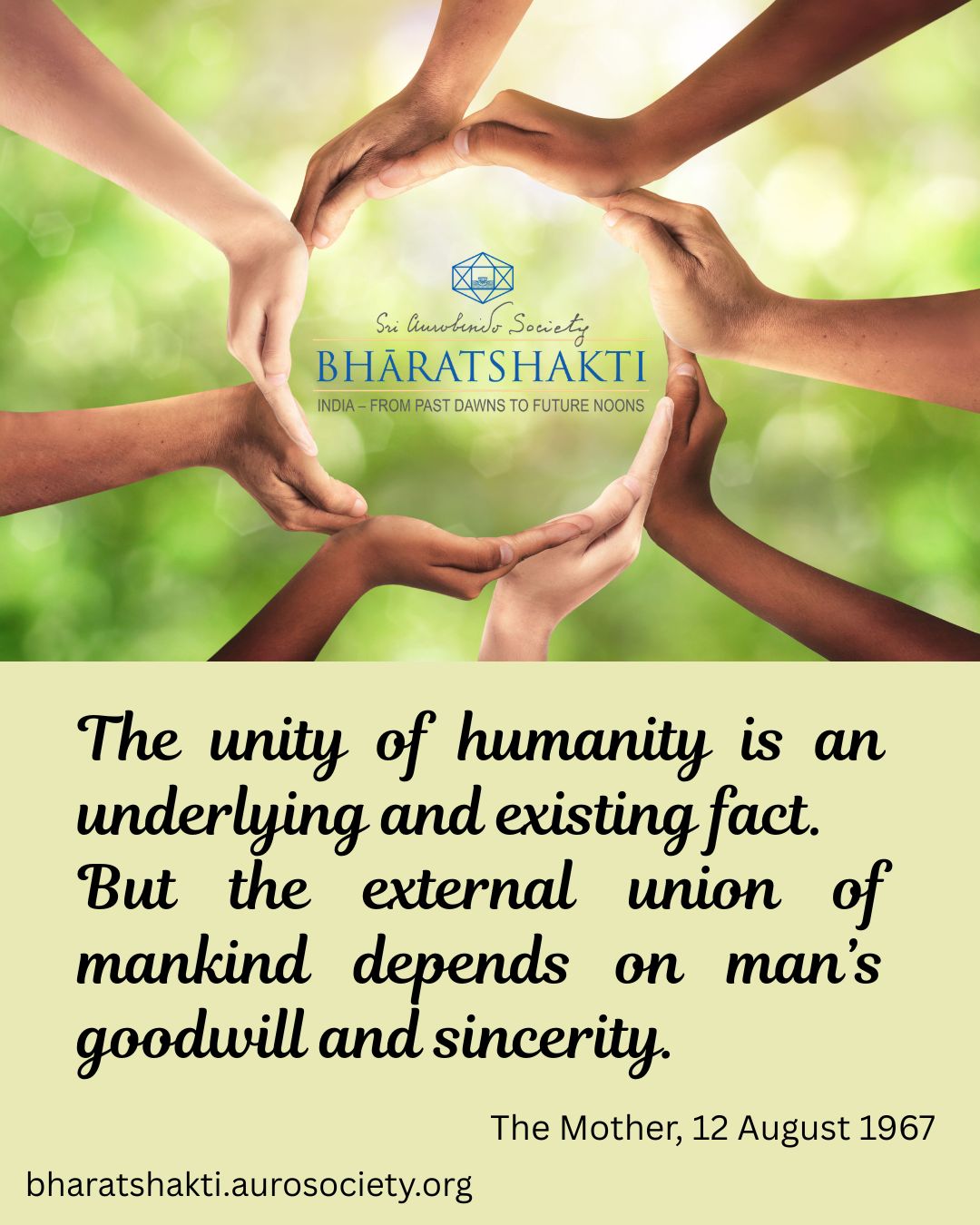
Yet from Sri Aurobindo’s larger evolutionary perspective, no political arrangement can be the final destination of humanity. National identities will continue to exist, but the ultimate movement is towards a consciousness in which the nation does not have to disappear in order for humanity to become one.
Sri Aurobindo expressed this beautifully in his Third Dream: nationalism would eventually fulfil itself and lose its militancy, while an international spirit and outlook would emerge, accompanied by new international forms and institutions. He even envisaged possibilities such as multilateral citizenship and voluntary cultural interchange.
Therefore, today’s political slogans may ultimately prove to be passing clouds in the longer history of India’s evolution. Even laws and political instruments that appear permanent today, including debates surrounding certain controversial topics, should be viewed in that larger perspective. They belong to a particular historical moment; they are not the destiny of India.
More by Sri Aurobindo:
An Ideal for the Future Progress of Humanity
The deeper question is: Will India use her freedom merely to become another powerful nation, or will she fulfil Sri Aurobindo’s vision of becoming a force for human unity?
The Mother herself spoke of India’s spiritual mission and of India having a role in leading humanity towards peace and a new world order. That is why I remain hopeful.
What appears today as fragmentation may eventually become the pressure through which a greater unity emerges. What appears today as conflict between generations may become a dialogue between experience and new consciousness.
What appears today as student unrest may, in some cases, become the beginning of a deeper demand for justice. And what appears today as the triumph of narrow nationalism may ultimately be recognised as only one stage in humanity’s longer journey towards unity.
I have lived long enough to have seen political systems that appeared permanent disappear. I witnessed the student awakening in Ethiopia in 1966. I have subsequently witnessed many other political transformations.
And now, looking at India and the world through the eyes of Sri Aurobindo, I feel that the real revolution is still ahead of us. It is not merely a revolution of governments. It is a revolution of consciousness.
Sri Aurobindo’s Third Dream therefore gives us reason not to despair at the turbulence of the present. The clouds may be dark, but they are not the sky. The names of political movements may change. Governments may change. Laws may change. National boundaries may change. But the evolutionary movement towards a greater human unity continues.
And, as Sri Aurobindo said in 1947, “a new spirit of oneness will take hold of the human race.” That, ultimately, is the revolution most believe we should be looking for.
I am not simply quoting Sri Aurobindo; but I am saying that I have seen in my own lifetime how the consciousness of students can become an historical force. And that fits beautifully with the larger arc of Sri Aurobindo’s five dreams: free and united India → resurgent Asia → world-union → India’s spiritual gift → a higher evolutionary consciousness.