
Date: May 25, 2026
Author: Beloo Mehra
A blog in the series – Films that Inspire
I lived in the USA for about 15 years but I never developed any taste for American football. I am one of the those Indians who don’t even care for cricket much. But that evening of March or April 2016, I found myself actually enjoying and liking a Hollywood film about football. American football, to be precise.
What I really liked about this film, based on a true story, was the fact that it isn’t really about football. The 2015 film, Concussion is actually about a doctor’s pursuit for truth.
Will Smith superbly portrays the character of Dr. Bennet Omalu, a well-mannered, polite and extremely likable Nigerian forensic pathologist working in a county coroner’s office in the city of Pittsburgh. The plot revolves around Dr. Omalu’s fight against the US professional football body, National Football League (NFL) which wants to suppress his research findings on chronic traumatic encephalopathy (CTE), brain degeneration suffered by professional football players due to repeated concussions.
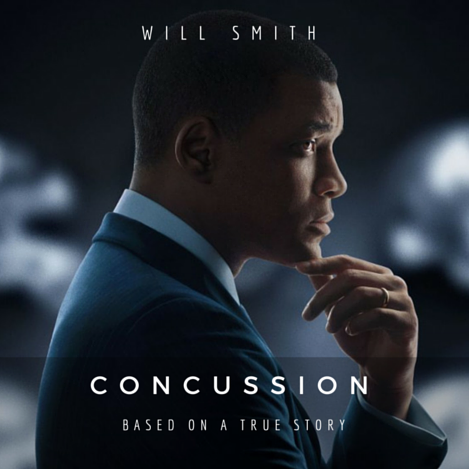
Here are four key things that I most appreciated in the film.
1. Endearing portrayal of a doctor, a man of science and his pursuit of knowledge
Dr. Omalu is a no-nonsense, serious guy, a doctor with many advanced degrees, who has no interest in football, who doesn’t even watch TV though he has one at home, because as he says, “that’s what Americans do, have a TV.”
But when he realises that he must know everything there is to know about football, particularly how a player gets repeated blows to his head, he does everything a committed researcher must do. Except playing football himself.
He watches numerous games and practice sessions, and watches them extremely closely – both on TV and on the field – to minutely notice the nature and severity of blows a player’s head receives. He studies the anatomy of various animals and birds to determine the severity of concussion they can bear, in comparison to an average human brain and explains:
“All of these animals have shock absorbers built into their bodies. The woodpecker’s tongue extends through the back of the mouth out of the nostril, encircling the entire cranium. It is the anatomical equivalent of a safety belt for its brain. Human beings? Not a single piece of our anatomy protects us from those types of collisions. A human being will get concussed at sixty G’s. A common head-to-head contact on a football field? One hundred G’s. God did not intend for us to play football.”
When he recognises the gravity of enormous damage that repeated concussions do to the brain of a football player, he arrives at a simple conclusion – “God did not intend for us to play football.” It is his sincerity and honesty which makes him especially endearing, and also helps the viewer see what he is up against. In this case, the gods of the football!
When Dr. Omalu realises that NFL wouldn’t care for his findings, in his characteristic innocence, he proposes a simple solution to the problem. To his boss, another likable character in the film, Dr. Cyril Wecht played by Albert Brooks, he says:
Dr. Bennet Omalu: I solved the problem. All they have to do is put on the side of the helmet, “The Surgeon General has determined that playing football is hazardous to your health.”
Dr. Cyril Wecht: You got to put it on *both* sides of the helmet.
This is a guy who spends his own savings to conduct as thorough a forensic investigation as necessary in the absence of official funding. He challenges a powerful organisation like NFL despite all kinds of threats, despite losing his job, home and their unborn child. He does all this because of his steadfastness to the truth. When he confronts and challenges a high-ranking official from the NFL, a doctor himself, one can feel the zeal for truth in his voice: “Tell the truth! Tell the truth!”
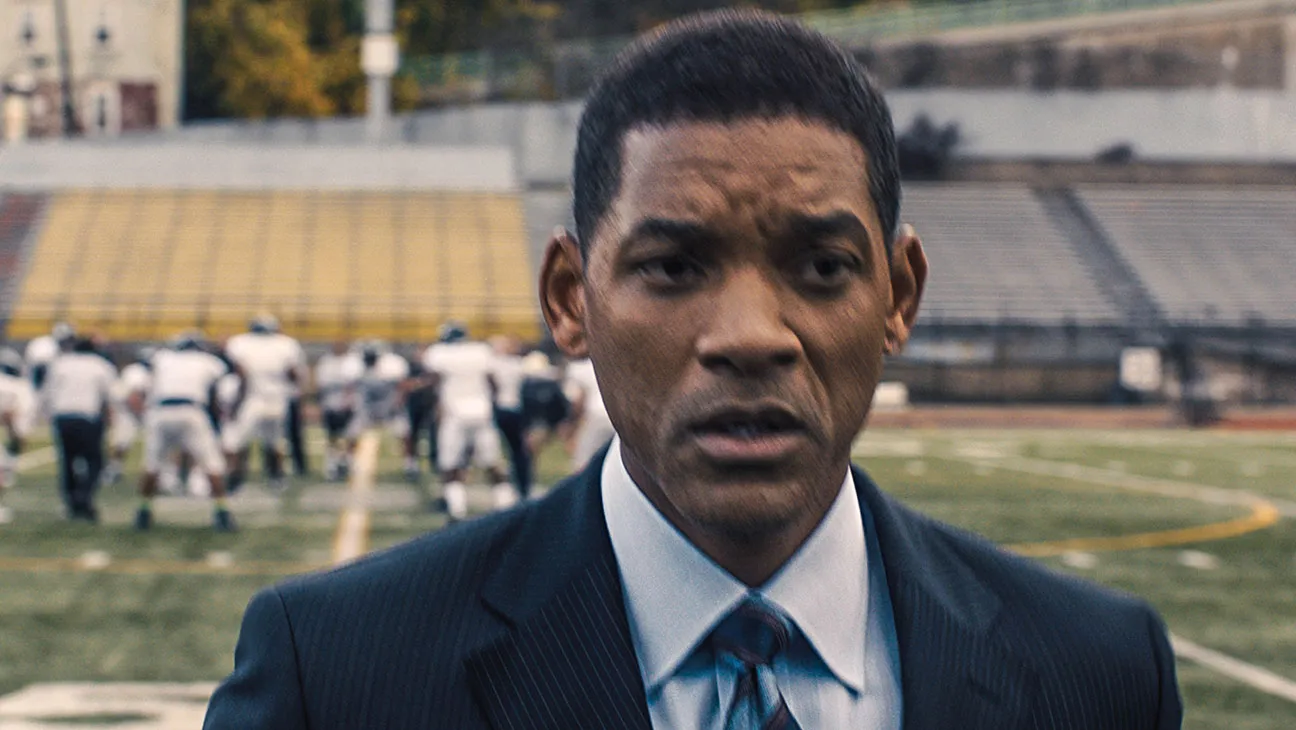
2. Conflict between a disinterested pursuit of truth and an interested repression of truth
In direct contrast to Dr. Omalu and his pursuit of truth, we have NFL which is actually aware of the repercussions of repeated concussions based on some findings of previous studies conducted by their own doctors. But NFL had suppressed those findings, lest they should harm the sport’s popularity.
Why would the NFL suppress the findings? The answer is obvious, and oh-so-American: “It’s the economy, stupid!”
Football like any other spectator sport anywhere is about money. BIG MONEY. But in American context, the big money is even bigger. Professional sports are important drivers of American economy. Tens of thousands of jobs all around the country are dependent on sport industries.
In America, football is also about a few other things. It is about winning high school games, which impacts school district’s finances. It is about securing college admissions. It is about machismo, about the great American value of competitive spirit. Anything which would harm football’s popularity, thereby negatively impacting future recruitment isn’t in the interest of NFL.
But as Dr. Cyril Wecht tells Dr. Omalu, there is more to football in America:
“The NFL owns a day of the week. The same day the Church used to own. Now it’s theirs.”
This religion-like status for football, thanks to the aggressive promotion by corporate sponsors, media and other interested parties, is perhaps a unique American phenomenon.
Europeans, South Americans1 and many others also love football (soccer, the real football as an Indian would say, not the American kind). But perhaps nowhere else we would find the same kind of collective-craze as Americans feel over superbowl.
This conflict between a disinterested and a steadfast pursuit of knowledge which doesn’t bend or compromise, and a seriously compromised organisational cover-up of the truth is well portrayed in the film. When Dr. Omalu is surprised that NFL isn’t interested in his findings, Dr. Cyril Wecht gives him a lesson in reality:
Dr. Cyril Wecht: [rhetorically] Did you think the NFL would thank you?
Dr. Bennet Omalu: [earnestly] Yes.
Dr. Cyril Wecht: What the hell for?
Dr. Bennet Omalu: For knowing.
Obviously, knowing isn’t enough for NFL to do something about the problem. Their interest is elsewhere.
3. Critique of excessive commercialisation of sports and science
“Commercialism is a modern sociological phenomenon; one might almost say, that is the whole phenomenon of modern society.” (Sri Aurobindo, CWSA, 25: 485)
Ours is the age marked by commercialism, by the “predominance of the economic man, the universality of the commercial value or the utilitarian and materially efficient and productive value for everything in human life” (ibid).
“Even in the outlook on knowledge, thought, science, art, poetry and religion the economic conception of life overrides all others…For the modern economic view of life…Science is of immense importance not because it discovers the secrets of Nature for the advancement of knowledge, but because it utilises them for the creation of machinery and develops and organises the economic resources of the community…” (p. 487)
A big chunk of scientific research in the US is funded by big corporations, which have obvious stake in the findings. This is also true of medical research. The film Concussion situates itself peripherally but firmly in this complex web of scientific/medical research being compromised because of commercial and economic interest, by focusing on the commercial nature of sport industry which tries to curb pure disinterested research.
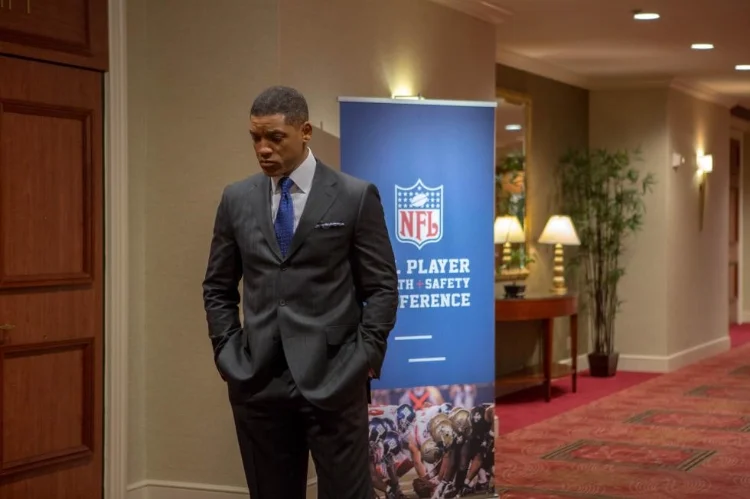
4. Remember who you are and do the right thing
In this context of science at the service of commercialism, we have Dr. Omalu, a sincere and honest researcher, pressured by NFL to bury his findings and not speak the truth. At one such moment when he feels completely disheartened, his wife, Prema Mutiso, played by Gugu Mbatha-Raw reminds him of who he is.
“If you don’t speak for the dead, who will? You are of the Igbo tribe, Bennet. When you have the truth, the thing you are told you cannot do is the thing you must do. Embrace that, and nothing created by man can bring you down.”
This reminder is especially important for Nigeria-born doctor, who has now built a successful life for himself in the USA. All through the film we are given many hints of how he has so carefully mastered the ‘American way’, despite facing some subtle and not-so-subtle racism that is part of the American experience for most immigrants, especially those from Africa. We hear Dr. Omalu fondly tell his wife what he thought of America as a child, “You could be anything, you could do anything – I never wanted anything as much as I wanted to be an American.”
But now that he is an American, he is being pressured to not do the one thing he really wanted to do – tell the truth. That’s when his wife’s reminder helps him wake up and remember who he is. He is of Igbo tribe, a tribe which lost much of its culture, religion, system of governance, law, education, customs, almost everything, to the horrors of British colonisation and consequent civil wars.
The loss of identity is the biggest loss under colonial experience.Only a process of going back to one’s cultural roots, a sort of a decolonising experience, can help one rediscover a rooted sense of identity, a sense of belonging in the post-colonial world. Only then would a person know how to successfully navigate through this multi-cultural world, rooting oneself in a core center but widening oneself to embrace the multiplicity.
That was Dr. Omalu’s moment of recognising his true identity. But this recognition was not only of his roots in an old pagan culture which had been destroyed by the greed and violence of a monotheistic modernity imposed by the colonialists. It is also, and perhaps more importantly, a deeper and truer recognition of himself as a scientist, a healer, a human being, who must do the right thing by speaking for the dead, those who died because NFL wouldn’t let the truth come out.
He must speak for the dead, and stand with the truth especially when everyone is telling him not to. Probably, that’s what his ancestors also did when faced with the threat of cultural annihilation and a complete loss of their way of life.
Watch a trailer of the film.
Notes
- I use words such as Americans or Europeans very broadly, fully realising that a lot of people everywhere, including the US, don’t care much, or at all, for football. Or any other sport. Just as many Indians don’t care for cricket. My intention is not to over-generalise or stereotype, but to speak of a wider social-cultural phenomenon. ↩︎