
Date: May 28, 2026
Venue: Online
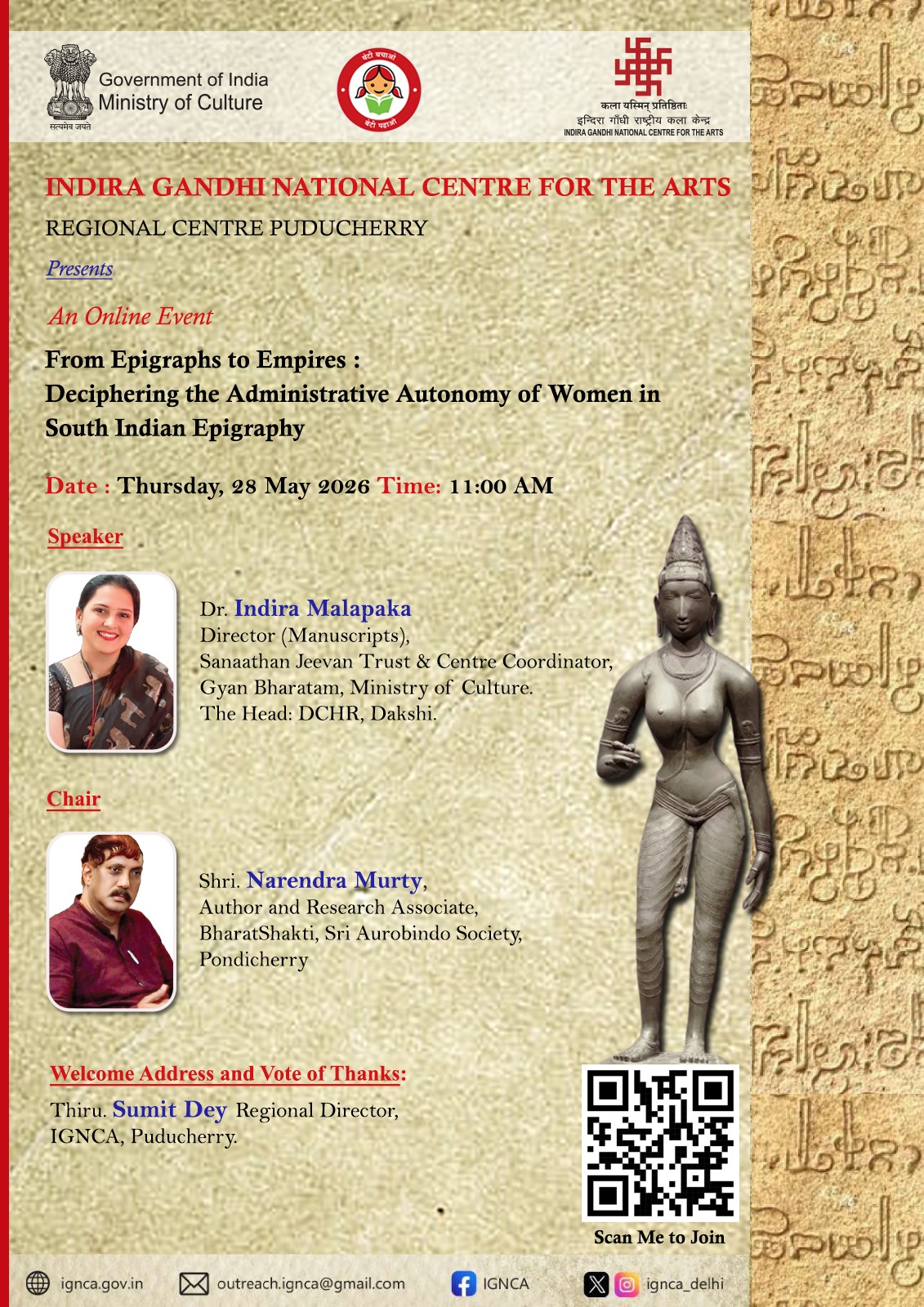
Mr. Narendra Murty, Author and Research Associate, BhāratShakti, Sri Aurobindo Society, Pondicherry was invited to chair a webinar titled ‘From Epigraphs to Empires: Deciphering the Administrative Autonomy of Women in South Indian Epigraphy’ organised by the Indira Gandhi National Centre for Arts, Regional Centre for Pondicherry.
The main speaker for the event was Dr. Indira Malapaka, Director (Manuscripts), Sanathan Jeevan Trust and Centre Coordinator under the Ministry of Culture. In his opening remarks Dr. Sumit Dey, Regional Director, IGNCA, Pondicherry introduced and welcomed the Chairperson Mr. Narendra Murty and requested him to introduce the speaker.
The Chair expressed his gratitude for being given the opportunity to host the event and introduced Dr. Indira by reading out her short biography. Thereafter, the speaker began her presentation by explaining the term “epigraphy” which is a scientific study of written texts engraved on stone, metal, wood or such durable material.
For her sources she mainly chose temple inscriptions and stone and wooden tablets that spoke about the role of strong, independent women who ran administrative functions of governance like tax collection, civic services, maintenance of law and order, even performing efficiently as judges and in combat roles as a part of the army.
The speaker gave short life sketches of many remarkable women in varied fields spread over all the kingdoms of Karnataka, Andhra Pradesh, Tamil Nadu and Kerala across ten centuries. These women came from every walk of life – queens, wives and daughters of noblemen, warriors, teachers and even from the lower strata on socio-economic ladder. They occupied important positions in administration and governance purely by dint of their merit and abilities. And all their deeds were recorded in epigraphy and still available for verification and research.
On conclusion of the presentation, Mr. Narendra Murty thanked Dr. Indira Malapaka and highlighted that many Indians and India enthusiasts are unaware of this very important aspect of Indian history, especially related to the great contribution of women as administrators and governors in the various kingdoms of South India. He also hoped that history books in Indian schools and colleges are modified suitably to highlight such strong women leaders.
The session was an eye opener for all the participants about this important aspect of history relating to women of Bharat. The session was concluded with a vote of thanks by Dr. Sumit Dey.