
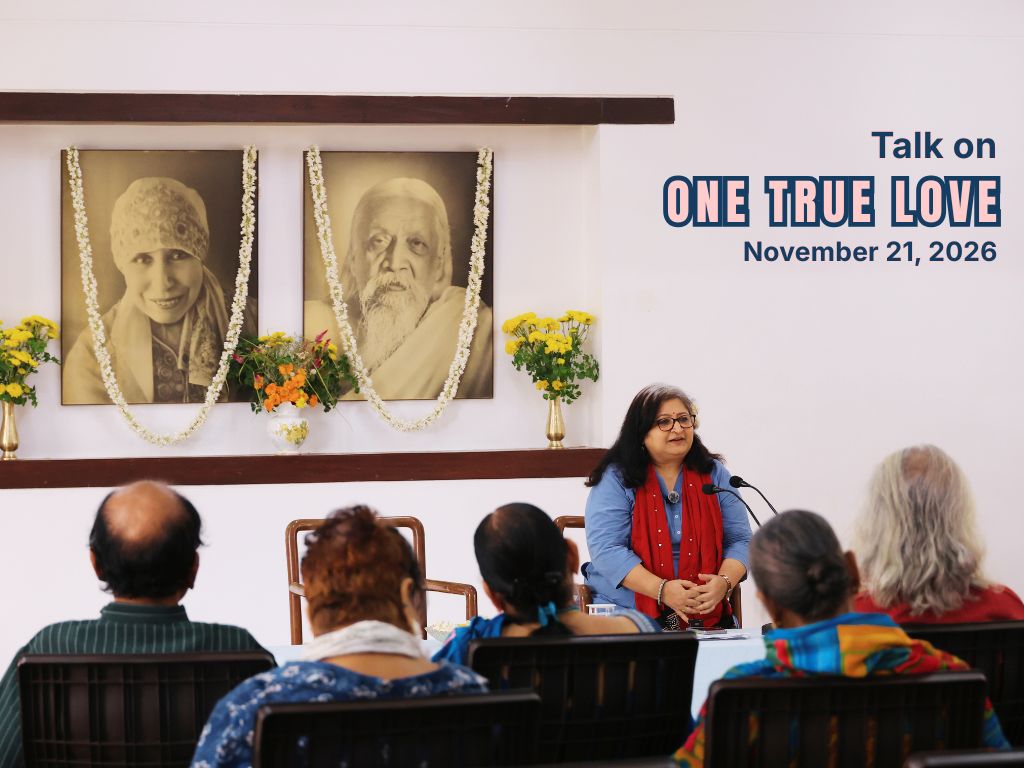
Date: November 21, 2026
Venue: Sri Aurobindo Society
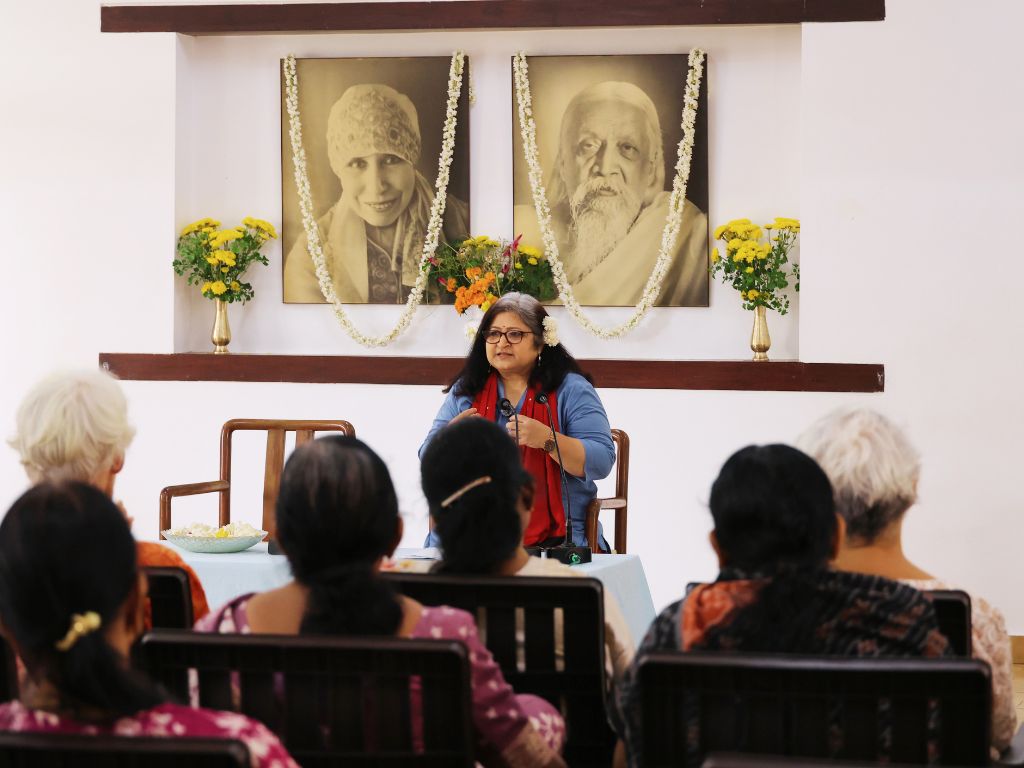
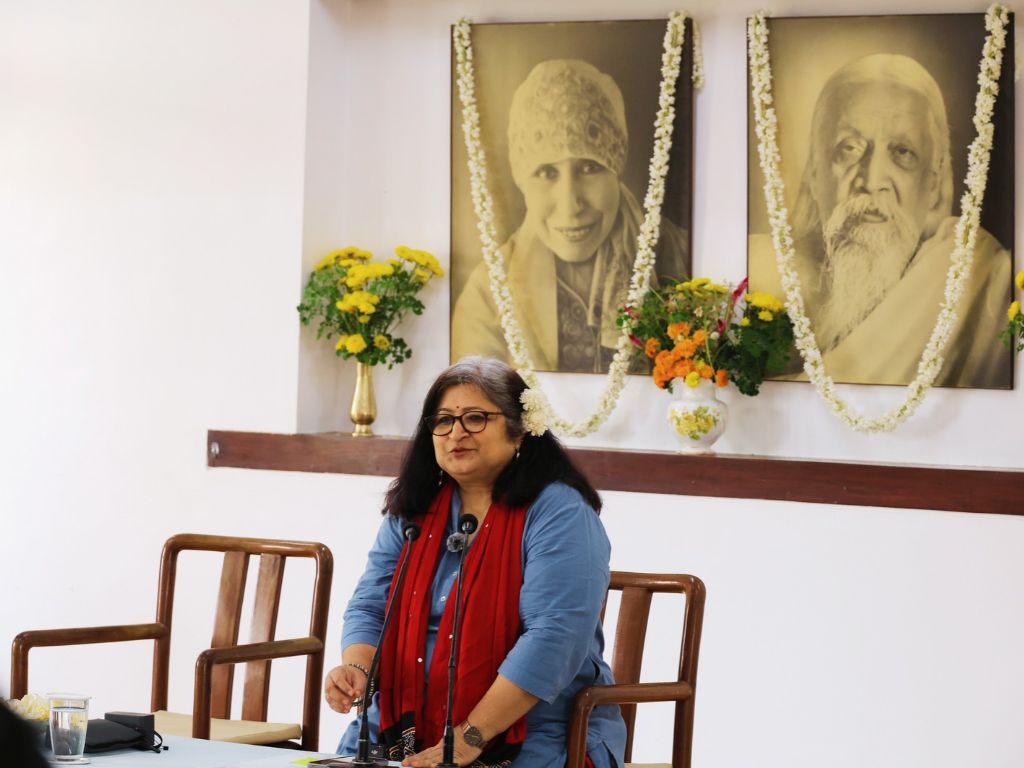
As part of the 2026 edition of Sri Aurobindo Society’s Annual Women’s Council Seminar (November 20-22, 2026), Dr. Beloo Mehra was invited to give a talk on Saturday, November 21. The seminar’s theme for 2026 was ‘Divine Love’. Keeping this in view, Dr. Mehra spoke on the topic – ‘One True Love’, drawing inspiration and insights from the writings of The Mother and Sri Aurobindo.
Dr. Mehra began by reading part of a prayer of The Mother dated December 20, 1916 (from Prayers and Meditations): “My soul is in prayer and bows down in love before what it can understand and know of Thee.” She said that this prayer suggests that we must first love the divine before we can hope to know anything of it. The “we” here is the soul, not the scattered surface self. Understanding of the divine and its ways of action comes much later.
She linked this to the Women’s Council theme and to Sri Aurobindo’s line, quoted in the seminar announcements, that bringing down Divine Love and Ananda is the essence and crown of Integral Yoga. She noted that love cannot be separated from delight, and that beauty, the third component highlighted in the announcements, belongs with them.
Dr. Mehra said that she titled her talk based on a phrase “One True Love” that she remembered reading in one of the works of the Mother. She traced the phrase to the ninth seminar of the New Age Association, held on 27 November 1966. The Mother started the Association in 1964 at the SAICE (Ashram school) as a forum for higher course students and their teachers to express what they were discovering within and learning from outside.
The seminar topic for November 1966 was “What is true love and how to find it?” The Mother’s short reply was that there is only one true love, the love from the divine, which in human beings turns into love for the divine.
Dr. Mehra’s talk stressed that these are not two separate loves. Quoting Sri Aurobindo and the Mother, Dr. Mehra described love in its essence as the joy of identity, expressed in the bliss of union. Identity points to oneness, and union to one rushing toward another. Love from the divine is the joy of identity, and in humans it becomes love for the divine, which is experienced as the bliss of union.
The Mother also added that the nature of the divine is love. Since integral yoga aims at transforming human nature into divine nature, Dr. Mehra called this an important clue: if the divine nature is love, then bringing down divine love is the essence of the yoga.
The Story of Creation
Dr. Mehra retold The Mother’s story of creation, highlighting a few key points.
- A supreme being, feeling alone, wills for a playmate, echoing the Taittiriya Upanishad line “Ekaki na ramate.” It externalizes its own consciousness and force, known in the Indian tradition as the Adi Shakti or Maha Shakti.
- A Divine Will arises for manifestation into multiplicity. Four beings emanate: consciousness or light, life, truth, and bliss or ananda. They are given complete free will.
- Using that freedom, they separate from the source and fall into inconscience, becoming their opposites: inconscience, death, falsehood, and suffering.
- The supreme then sends a ray of Love deep into the inconscience, along with the four original gods of light, life, ananda, and truth. Love at the very bottom makes it possible for life to emerge in matter and mind in life.
Dr. Mehra noted that The Mother says the four hostile beings were not accidents. They were the first children of the Divine Shakti and can still be transformed. Divine Love also remains in the Transcendent Sacchidananda, because the Supreme Consciousness is always in identity with Supreme Being in that poise.
Dr. Mehra said that this story of creation helps us understand how the Love from the Divine which has descended into Matter makes it possible for the love for the Divine to emerge from below. Any transformation is possible because of the meeting of a pull from above and an aspiration from below. Divine love above acts like a magnetic force, and the love below responds.
Dr. Mehra connected this to the triple labor of aspiration, rejection, and surrender. She added that the Mother explicitly links the highest form of aspiration to a love that is entirely free of ego and self-interest. The Mother’s “master formula” is that like recognizes like: love recognizes love. Because the divine’s nature is love, the love in us recognizes it and climbs toward it. We begin where we are, with ordinary human loves mixed with desire, demand, and ego.
Love in Savitri
Dr. Mehra observed that Sri Aurobindo explored love and death throughout his poetry and drama, from the early narrative poem Love and Death to Savitri, which she called the far more evolved expression of love conquering death for entire humanity. She read two lines from the canto Satyavan from The Book of Love: “To live, to love are signs of infinite things. Love is a glory from eternity’s spheres.”
She then read at length from the Book of Fate. Queen mother urges Savitri to choose again, since “love dies in the breast before the lover” and life needs practical support. Savitri refuses, answering that her will is part of the eternal will and that she has found “the deep unchanging soul of love.”
Dr. Mehra related this to Sri Aurobindo’s letter written to his father-in-law on the death of his wife, in which he wrote that where he has loved once, his affections remain forever. After reading the passage from Savitri, she pointed to a few lines which help us understand about “how to love” and the relation between Love, Will and Strength illustrating that human love can be seen as a training ground, “from nursery to PhD,” whose culmination is to see the eternal in a human face.
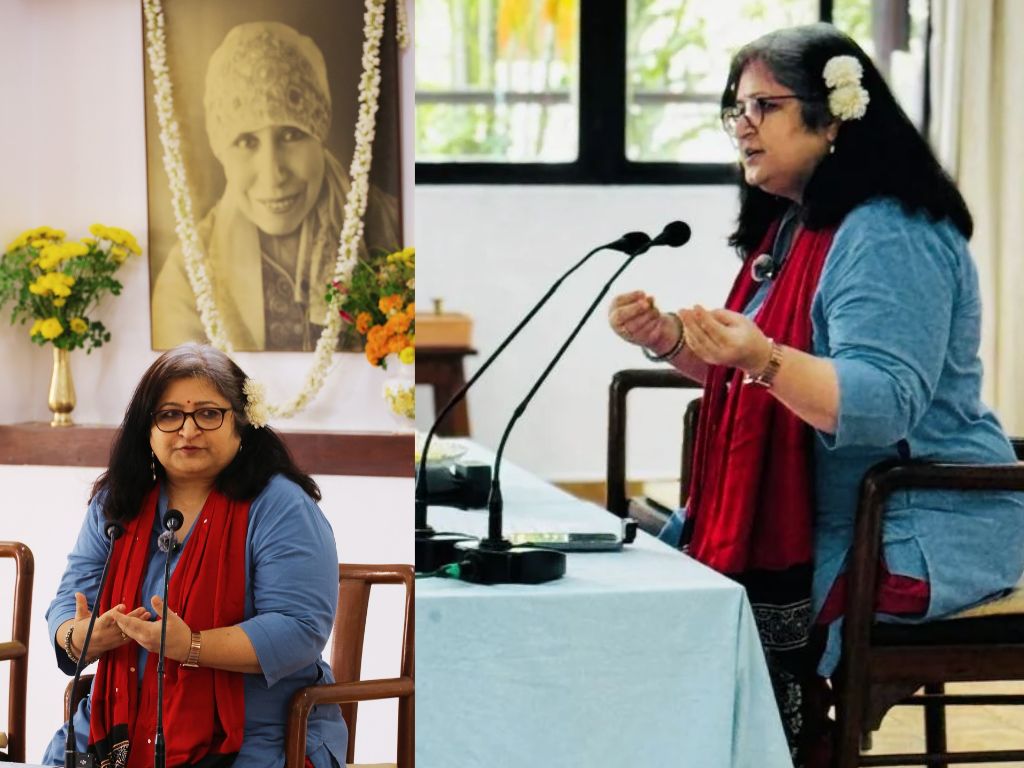
Towards the end, Dr. Mehra spoke briefly about what is meant by psychic love as compared to the traditional understanding of Bhakti or devotion which expresses in various forms – such as that of Dasya, Sakha, Vatasalya or Madhurya. Speaking of the significance of self-giving in both Bhakti and Love, Dr. Mehra also highlighted the subtle but important difference as pointed out by Sri Aurobindo.
To conclude, Dr. Mehra said that love is not merely a human emotion to be managed but a divine force already present in every being, even in the depths of inconscience. Our task is to go deep into whatever love comes to us, find its soul, and let it grow into love for the divine. In this view, the essence and crown of the yoga is to bring that love down and live it.
Recording will be available shortly.