
Date: November 20, 2026
Venue: Online
BhāratShakti, Sri Aurobindo Society organised an interactive session with author Dr. Charan Singh Kedarkhandi regarding his newly released voluminous book in Hindi – पूर्णयोगेश्वर श्रीअरविन्द: जीवन, साधना और सन्देश. This online session held on November 20, 2026 was part of BhāratShakti’s SAMVĀD: The Book Series, which celebrates Authors, Books, and Booklovers. This particular edition of the series was held in Hindi.
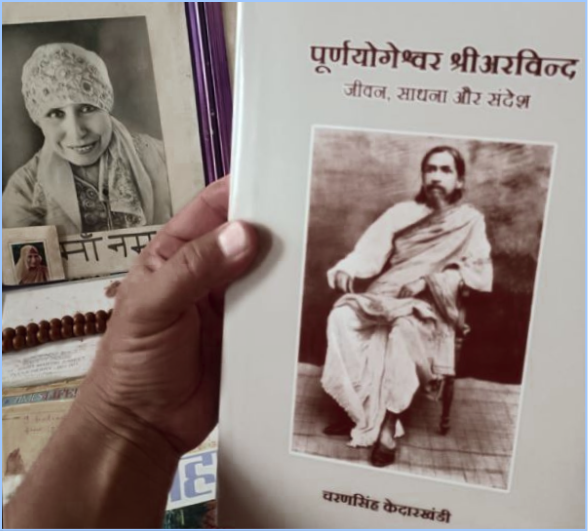
About the Book
This 778-page book is the most voluminous book in Hindi so far on Sri Aurobindo’s life and legacy and his vision of a ‘Divine Life on Divine Earth through a Divine Humanity’. The author has discussed in detail the intricacies and subtleties of the key foundational concepts of Sri Aurobindo’s Spirituality.
A striking feature of the book is the author’s deliberations on contemporary problems in the light of Sri Aurobindo’s and The Mother’s wisdom. Chapters on spiritual socialism, the ubiquitous challenge of war and man’s tribal violence, the problem of poverty, India’s caste conflicts and the perpetual disharmony between Hindus and Muslims must be seen in this light.
The word ‘Poornayogeshwar’ is the author’s coinage and has been used for the first time for Sri Aurobindo.
The book is published by Sri Aurobindo Study Centre, Jyotirmath, Uttarakhand and printed at Sri Aurobindo Ashram Press Puducherry. The book has been published by the generous financial support from Laxmipat Singhania Education Foundation and the grant was facilitated by Sri Aurobindo Hindi Zonal Committee, Noida, Uttar Pradesh.
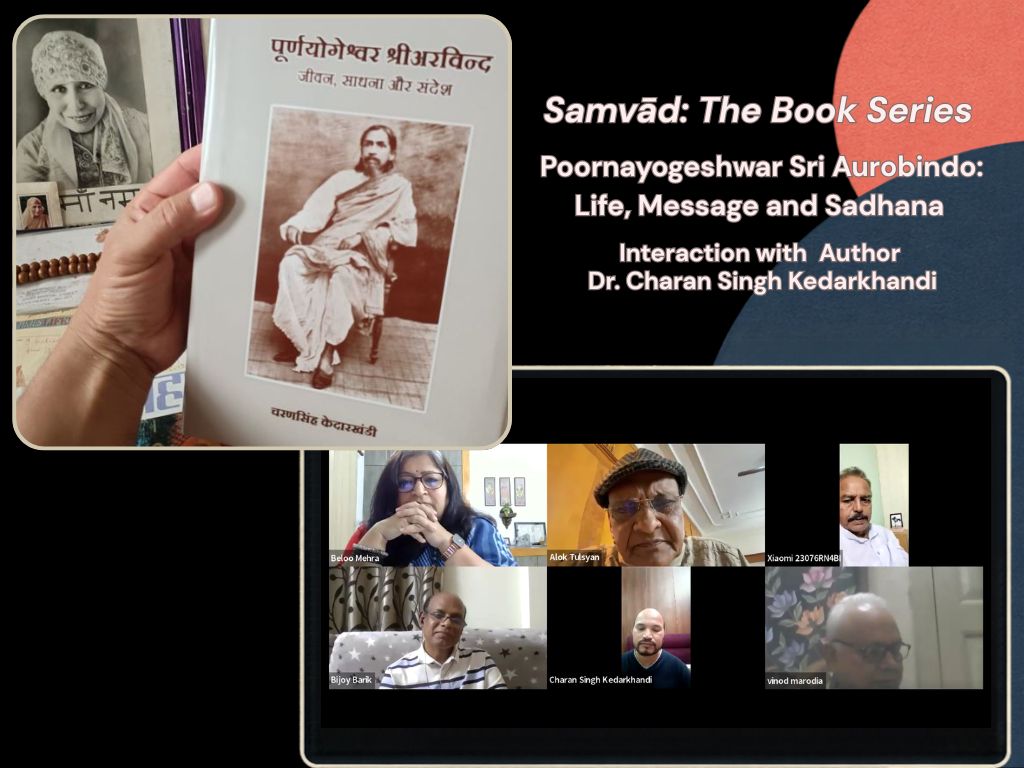
Interaction with the Author
Dr. Beloo Mehra, Director, BhāratShakti, SAS was the host and moderator for the interaction on November 20. Other participants in the interactive session included Shri Vinod Marodia from Sri Aurobindo Society, Ranchi, Shri Alok Tulsyan from SAS Centre in Daltonganj, Jharkhand, Shri Ashok Pawar from SAS, Jhansi.
The session opened with a moment of silent concentration. The conversation ran for about an hour and a half, moving from the book’s origins and language to aspects of life at Sri Aurobindo Ashram, topics connected to collective life as covered in the book, as well as specific themes of war, love, and the role of silence. A few questions and sharings from the audience closed the programme.
Summary of the Interaction
Based on her reading of the book, Dr. Mehra had identified a few specific questions for the author, Dr. Charan Singh Kedarkhandi which became the focus of the conversation for the first part of the session. In the remaining part of the session, other participants brought in a few additional questions and reflections.
In her introductory remarks Dr. Mehra described the book as a remarkable and ambitious project which covers many significant aspects related to Sri Aurobindo’s Life, Sadhana and Message in 40 chapters. Admiring the book’s broad vision, she said that she could feel the Mother’s Presence throughout, not only in the chapter devoted to her. The first few chapters (the preface, Sri Aurobindo’s outer life, the Mother’s story and their meeting) can be read quickly, but the later chapters on sadhana and on contemporary India and the world call for patience and deep reflection, she said. She invited Dr. Kedarkhandi to share a bit of his writing journey.
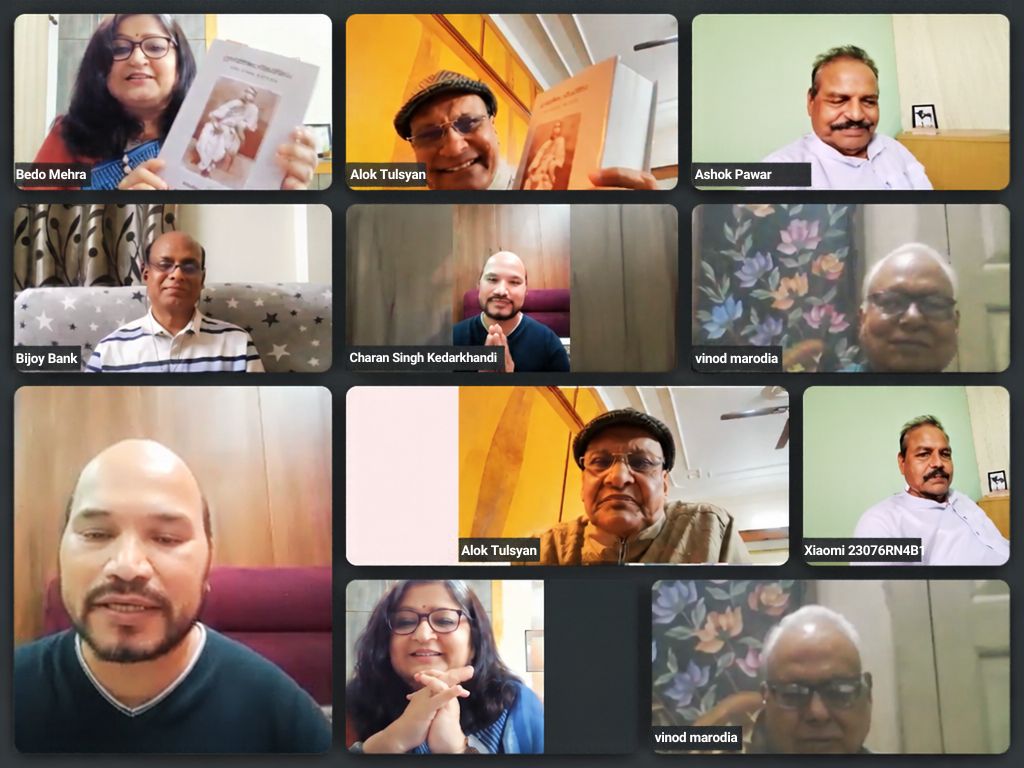
Dr. Charan Singh Kedarkhandi started off by quoting from Margaret Woodrow Wilson, daughter of U.S. President Woodrow Wilson, who had said of Sri Aurobindo: “Here is one on earth whom one can love all one’s life and in whom one can lose oneself.” He informed the participants that he began writing in Navratri 2021 and the book went to press around Navratri 2025.
He had planned 52 or 53 chapters but kept to 40 as it grew. Topics such as Auroville and Matrimandir were left for a planned second volume. He credited any completeness to the Mother’s Grace and any flaws to his own limitations as an instrument.
Dr. Charan Singh said that Hindi readers often complain that when translating Sri Aurobindo’s literature in Hindi, often some difficult terms and complex phrasing are used making the work hard to follow by a general reader. He wanted to write a book that conveys the message to ordinary readers in everyday Hindi/Hindustani, while also remaining useful to sadhaks who are more conversant with Sri Aurobindo’s vision and works. Savitri quotations were kept in English, as Dr. Mehra noted, because translating them would take away the original beauty and delight which can only be experienced when read in original English.
Another significant aspect of the book, Dr. Mehra said, is that it addresses the people of India, especially the youth of India in a highly approachable manner. The author’s voice does not come out from some high pedestal, rather the author’s voice carries the angst that many readers may have about the current state of affairs – whether it has to do with matters of nation, society or culture. And that makes all that the author describes about a topic relatable for the readers.
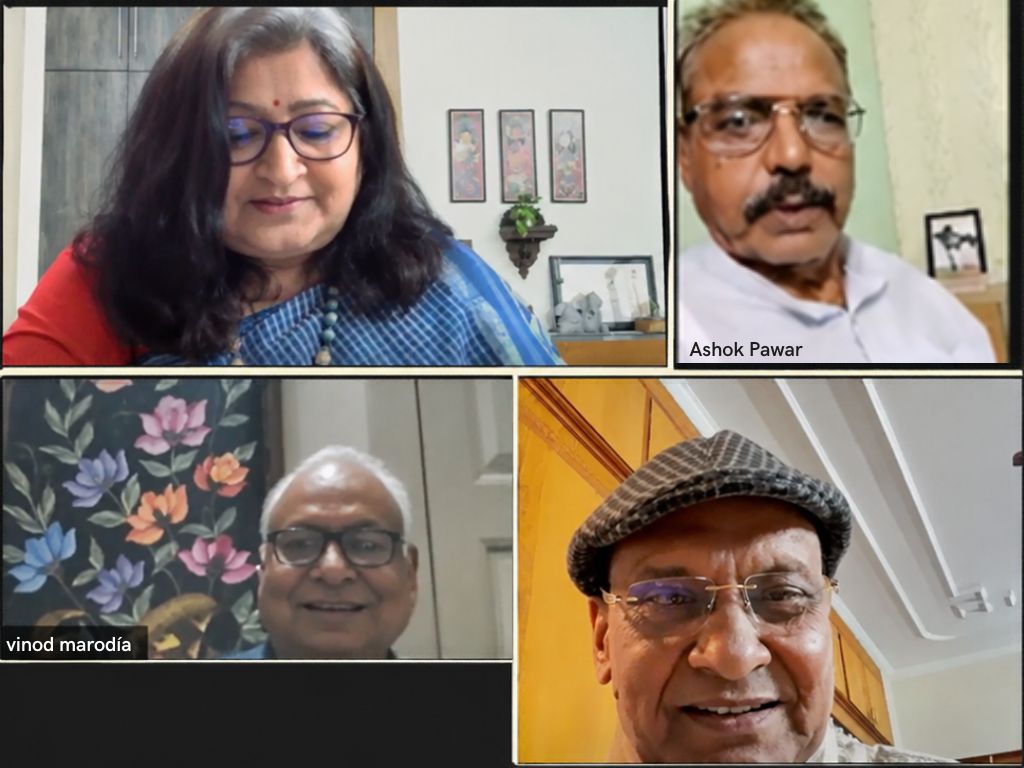
For an example of this, Dr. Mehra read out a short extract from the chapter on Sri Aurobindo Ashram, where the author candidly says that many present-day ashrams and pilgrimage sites inspire little trust and resemble hotels. In response, Dr. Charan Singh added that most temples offer no chance to be quiet before God; by contrast, he described the Pondicherry Ashram as a piece of the Himalayas in a desert, where order, work and sadhana are joined. He said he deliberately avoided pure praise, and described how one rude exchange at the Ashram archives led him to reflect that the Ashram’s punctuality and discipline rest on an inner spirit.
Dr. Mehra then brought attention to the point that the book also deals with a lot of practical topics concerning the collective life in a society or nation – whether it has to do with money, gender relations, social equality, war, democracy, poverty, altruism and more. These topics are obviously very important in Sri Aurobindo’s and the Mother’s whole, integral vision. But somehow they have been a bit sidelined by many scholars of Sri Aurobindo Studies. Or at least they have not been dealt with as much depth and urgency as say themes from works such as The Life Divine or Savitri. She asked the author to speak a little about his thought process when he decided to take up these types of topics in his book.
Dr. Charan Singh said that no important part of life should be excluded from spirituality — this is perhaps the most important message of Sri Aurobindo which must reach particularly the youth of India and the world. Time for ascetic spirituality is over, the world needs practical spirituality which can make earthly life divine. Key points which came up during this part of the conversation were:
- Charity and dharma: charity or altruism is often mistaken for spirituality; ritual and temple-going are only one aspect, and the goal is to become the temple.
- Youth: a communication gap between parents and children leaves young people disconnected from India’s deeper heritage. For instance, few know that Sri Aurobindo called for complete independence early on.
- Democracy: it should not be a monarchy of one leader or idea, and Sri Aurobindo held that uniformity is not the law of life; Sanatan survived by accepting diversity.
- War: it will not end until brotherhood of the soul arrives; Dr. Mehra recalled her unsuccessful attempt to start a study circle on War and Self-Determination at a university and offered to help the author bring such material into colleges.
- Humour: a chapter on humour shows Sri Aurobindo as a “smiling master”, suggesting the important role of cheerfulness and delight in yogic journey.
Mentioning about the chapter on varna, jati and caste, Dr. Mehra suggested that perhaps a more detailed discussion on this can be done at a later point given its significance for contemporary Indian society and polity. For the moment, there were still too many other important aspects of the book that must be reflected upon.
Bringing the focus on the chapter titled Love as the bridge between earth and heaven, Dr. Mehra asked the author about his thinking behind including this as a separate chapter. Dr. Charan Singh called love a core message and the essence of Sri Aurobindo’s sadhana. He cited the Mother’s image of love as the thread holding together the flowers of the divine bouquet, and Savitri‘s line that love is still the godhead by which all can change. He briefly recounted Sri Aurobindo’s story titled The Ideal of Forgiveness which features illustrates a very high ideal of love. He also noted that Sri Aurobindo’s writings – even his political writings and speeches – show little bitterness toward opponents.
Dr. Mehra then invited questions and reflections from other participants in the session.
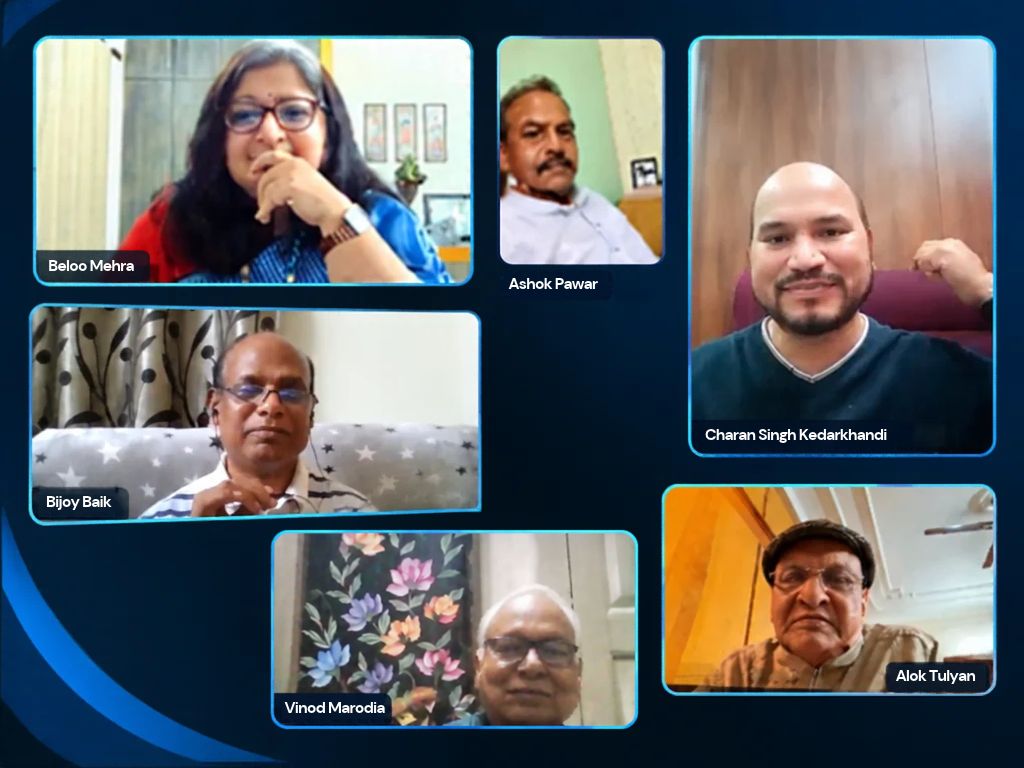
Shri Vinod Marodia highlighted an idea from the book, namely, political freedom has not meant inner freedom and asked for further elaboration. In his response, Dr. Charan Singh took a few examples from Sri Aurobindo’s writings which urge youth to become Indian in the true sense. Drawing on writings such as The Ideal of the Karmayogin and Bhavani Mandir, he spoke of the necessity to build strength in all fields, moral, intellectual, economic and above all spiritual.
Shri Sunder Subramanian asked how words can express what lies beyond them, and what is the role of silence in inner journey. The author replied that words are for those who do not understand silence, and that silence is the final limit of communication. He cited the traditional Indian perspective on four levels of speech, the Buddha’s silent teaching, and Savitri’s lines on light coming through the mind’s silence. Shri Narendra Murty added Sri Aurobindo’s remark to Nirodbaran that he had written only about 10 percent of what he knew.
Shri Alok Tulsyan and Shri Ashok Pawar both praised the book and offered to circulate it in schools and colleges in their areas. They agreed that the book should be read topic by topic, like the Ramcharitmanas.
In closing, Dr. Mehra thanked everyone and said she hoped to hold a second session about this book as many important topics could not be taken up this time.
About the Author
Based in Himalayas, Uttarakhand, Dr. Kedarkhandi is a seeker and follower of Sri Aurobindo’s spirituality and works as a professor with the Department of Higher Education, Govt. of Uttarakhand.
To purchase the book, contact the author: <[email protected]> / 9897214726. The book is also available for sale at Sri Aurobindo Bhavan, Noida.
Recording of the conversation will be available shortly.
For more of BhāratShakti’s work featuring books and authors, click HERE.