
Date: May 28, 2026
Venue: Sri Aurobindo Society
India had conceived the whole philosophy of her art, early on in the Vedic period itself, emphasises E.B. Havell in Ideals of Indian Art. The highest vision of the Vedic seers, the vision of the Infinite that is revealed and yet hidden in all the finite forms of the existence, materialised in the later periods in the wonderful forms of all Indian art. Sri Aurobindo reminds us that the “whole basis of Indian artistic creation, perfectly conscious and recognised in the canons, is directly spiritual and intuitive.” (CWSA, 20: 257)
The deep connection between Indian art and sacred ritual, right from the Vedic yajña, continues till today in myriad forms of temple worship. The outer ritual of yajña may be seen as a sacred theatre engaging all the senses. And it facilitates a revelation or a realization or a moment of transcendence. Such experience is also possible when one stands before a great work of art.
The great temples of India are magnificent works of art; so are the countless sculptures that make the temple — inside and outside.The temples were also designed to host various kinds of cultural performances and educational and social activities in the various manadapa-s, further emphasising the sacred dimension of all arts.
Inspired by these ideas, BhāratShakti, Sri Aurobindo Society will be conducting a workshop on the theme of ‘The Sacred in Indian Art’ on May 28, 2026. This is part of Yuvā Shakti‘, the learning initiative developed by the department for the youth from Sardar Patel University under which a vareity of educational programmes have been conducted for the last three years.
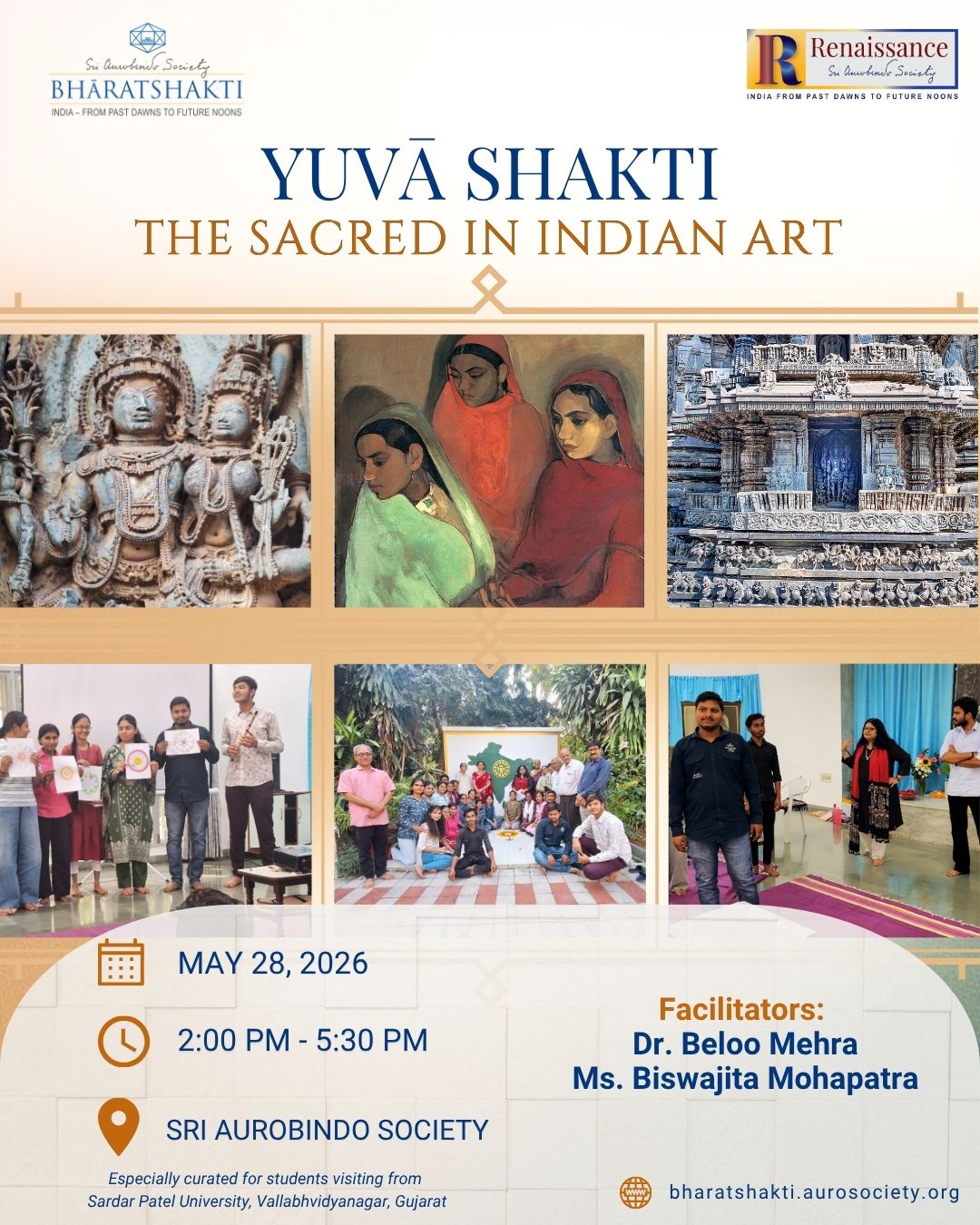
This year, the programme was planned in two phases. The first phase involved about 40 university students, and the workshop titled ‘Know Bhārat Through Art‘ was conducted at Sri Aurobindo Sadhana Kendra, Vallabh Vidyanagar. The second phase will involve about 25 students and shall be conducted at Sri Aurobindo Society in Pondicherry on 28th May.
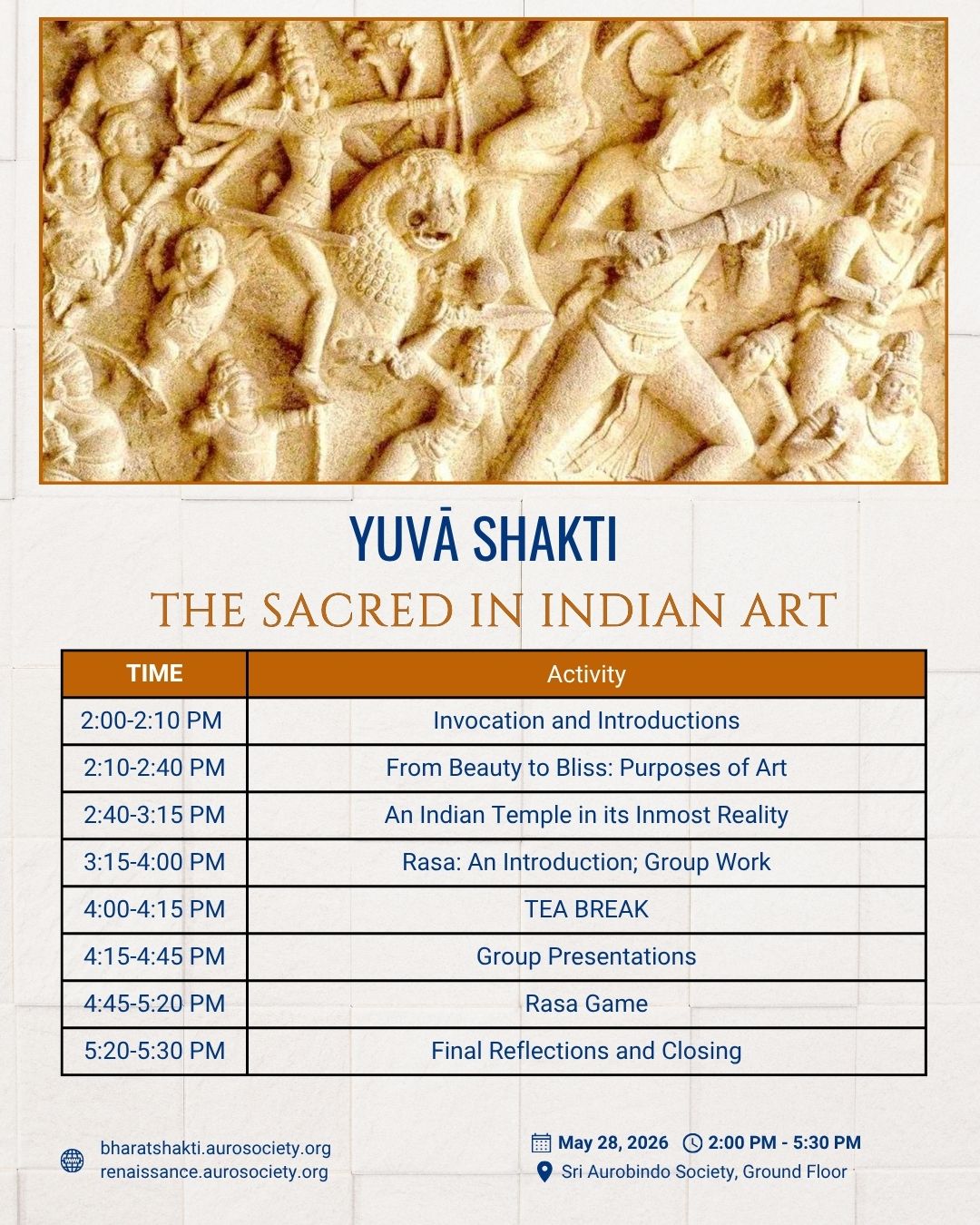
The workshop will include interactive sessions, video-based presentations, group work and engaging activities. Dr. Beloo Mehra will be the key facilitator from BhāratShakti department, while Ms. Biswajita Mohapatra will assist with the activity-based sessions.
The workshop will highlight that Indian art, at its highest, is identical in its spiritual aim and principle with the rest of Indian culture. Through some engaging activities, students will also be introduced to the concepts of Rasa and Bhāva – two key terms in Indian theories of Aesthetics and Art Appreciation.
To know more about BhāratShakti Workshops see HERE.
To know more about BhāratShakti programmes under the theme Art and Spirituality see HERE.