
Publication Date: August 2026
Author: Beloo Mehra
Sri Aurobindo Mandir Annual | Anukampa – The Grace Divine
Two new articles were recently published in national journals related to Sri Aurobindo Studies.
Sri Aurobindo and the Fundamentals of Sanatana Dharma
Published in Sri Aurobindo Mandir Annual, 2026
EXCERPT
When we speak of Sanatana Dharma, we are truly speaking of the soul of Indian Culture, the soul of Bharat, because this is the highest that the collective aspiration of the “consciousness of life” that has blossomed and flourished in this land for several millennia. But what is Sanatana Dharma? Most Indians grow up hearing that Sanatana Dharma, or what later came to be known as Hinduism, is not a religion but a way of life. But what exactly is meant by ‘way of life’? A term such as ‘way of life’ may include the highest and deepest ways of understanding and practicing the mysteries of Yoga to merely being concerned about outermost conduct without any regard to inner progress. Or it may also be that one may commit all kinds of acts with no conscious awareness, and say this is also a way of life. Thus, it is important to understand what is this ‘way of life’ that we understand as Sanatana Dharma.
Sri Aurobindo gives us a deep and comprehensive understanding of Sanatana Dharma. In many of his writings we find that he uses three terms Sanatana Dharma, Hinduism, Indian religion, often interchangeably. It is important to know that when he speaks of Indian religion, he is speaking of what we know today as Hinduism, but also includes Jainism, Buddhism, and Sikhism – all the paths that emerged from within the Sanatana Dharma fold. In this article, I have collated a few of these points with a focus on what he calls the fundamentals of Sanatana Dharma.
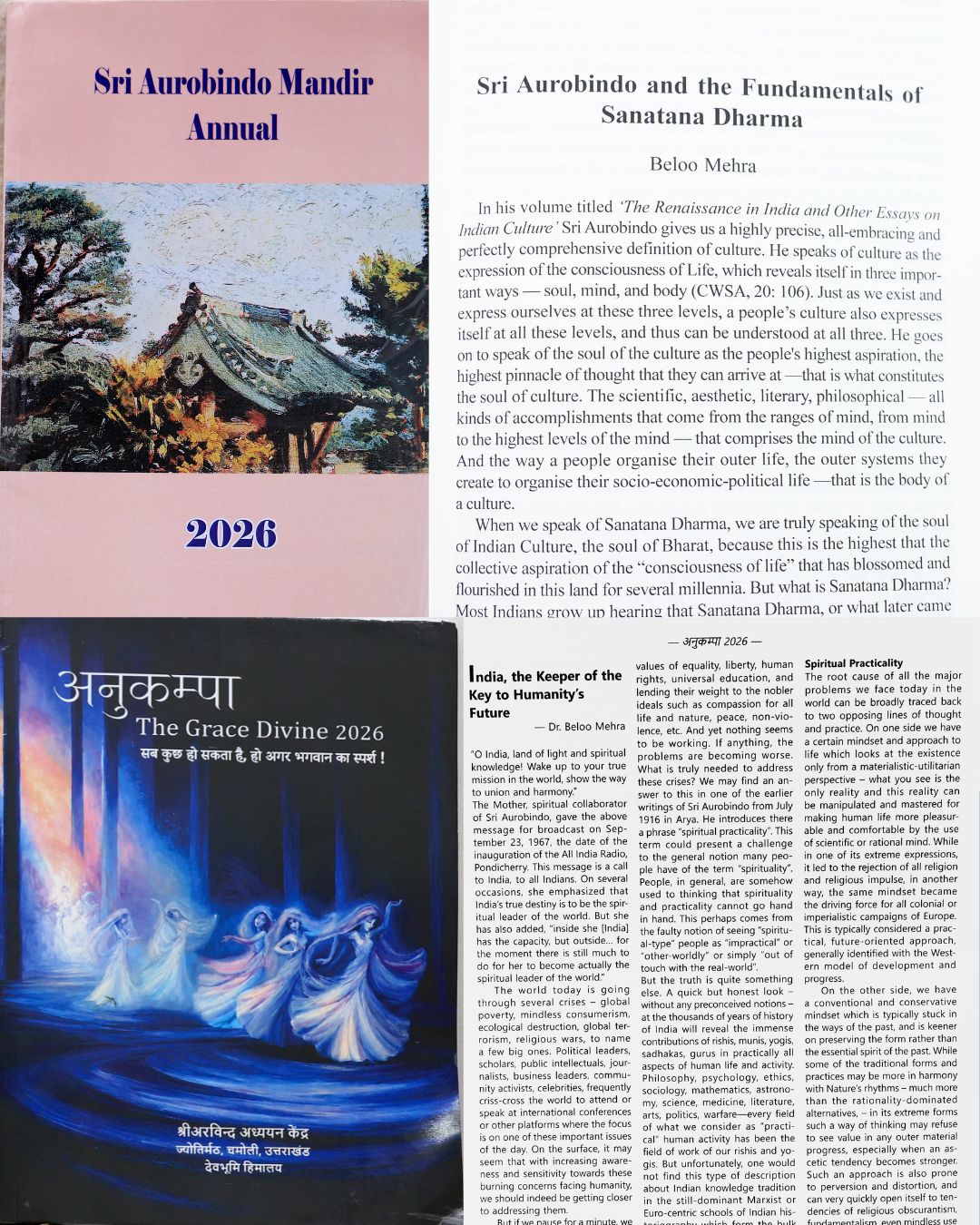
India, the Keeper of Key to Humanity’s Future
Published in Anukampa, The Grace Divine, 2026
EXCERPT
The world today is going through several crises – global poverty, mindless consumerism, ecological destruction, global terrorism, religious wars, to name a few big ones. Political leaders, scholars, public intellectuals, journalists, business leaders, community activists, celebrities, frequently criss-cross the world to attend or speak at international conferences or other platforms where the focus is on one of these important issues of the day. On the surface, it may seem that with increasing awareness and sensitivity towards these burning concerns facing humanity, we should indeed be getting closer to addressing them.
But if we pause for a minute, we may realise that the very frequency and frenzy of such deliberations actually speaks of the inadequacy and the insufficiency of the mental ideas and opinions expressed and shared at these gatherings. In their own ways, peoples, communities and nations are trying to address these conflicts and challenges using several approaches, such as through passing reasonable laws and formulating appropriate policies, launching relevant institutions which promote all the ‘right’ secular values of equality, liberty, human rights, universal education, and lending their weight to the nobler ideals such as compassion for all life and nature, peace, non-violence, etc. And yet nothing seems to be working. If anything, the problems are becoming worse. What is truly needed to address these crises?
We may find an answer to this in one of the earlier writings of Sri Aurobindo from July 1916 in Arya. Heintroducesthere a phrase “spiritual practicality”. This term could present a challenge to the general notion many people have of the term “spirituality”. People, in general, are somehow used to thinking that spirituality and practicality cannot go hand in hand. This perhaps comes from the faulty notion of seeing “spiritual-type” people as “impractical” or “other-worldly” or simply “out of touch with the real-world”.
But the truth is quite something else.

For copies of these articles, contact: <[email protected]>