
Date: August 18, 2026
Venue: The Unity Pavilion, Auroville
As part of the celebrations marking the 154th Birth Anniversary of Sri Aurobindo, the Unity Pavilion, Auroville, invited Dr. Beloo Mehra, Director, BhāratShakti, Sri Aurobindo Society to deliver a talk on the topic “Indian Renaissance for a New World Culture”.
Through the deeper ideas of consciousness, unity, education, culture, and human transformation, Dr. Mehra’s talk invited the audience to reflect on India’s cultural renaissance and its relevance to the emergence of a new world culture. It focused on culture as a force for human transformation and thoughtfully connected India’s cultural heritage with humanity’s future.
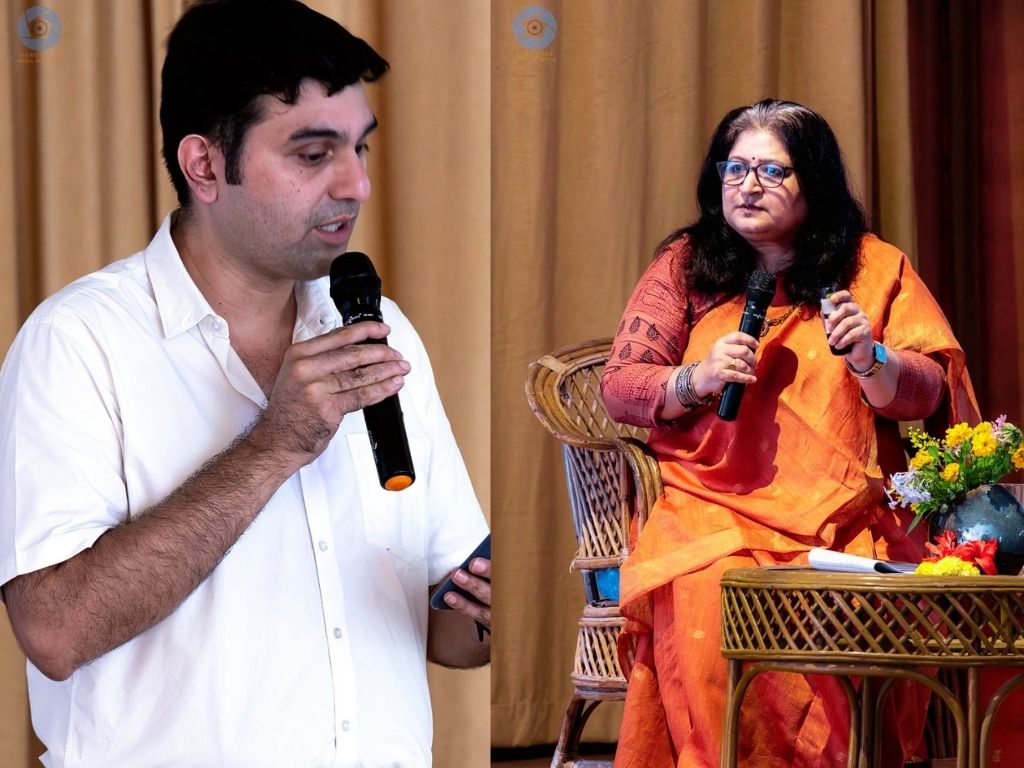
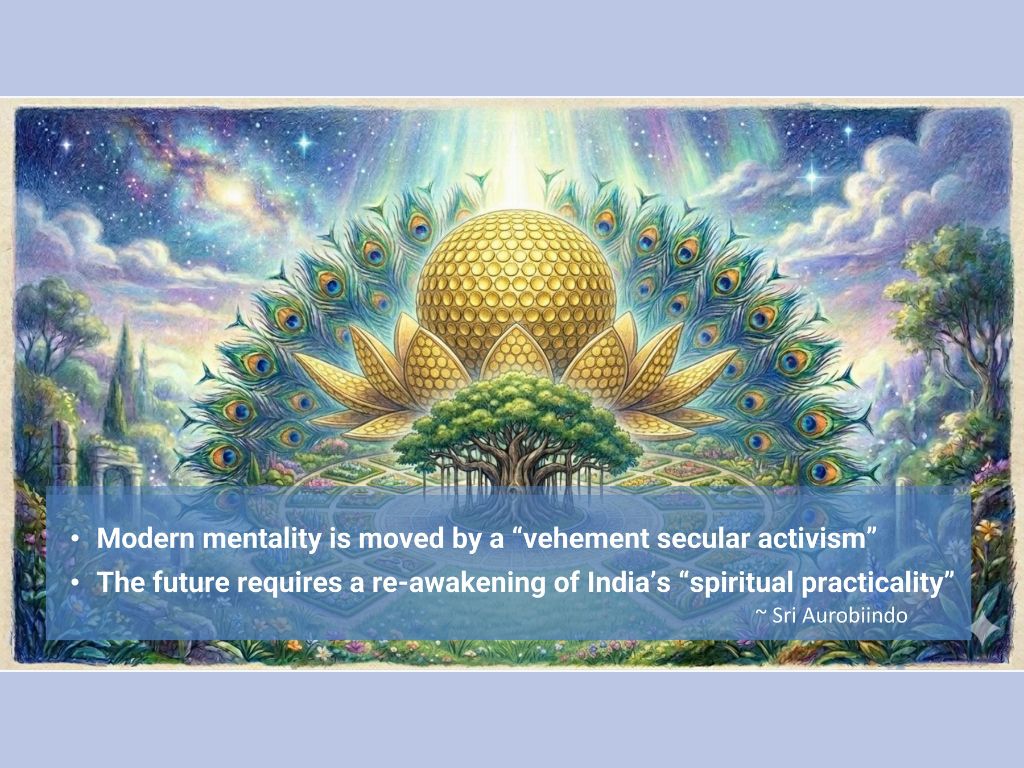
Sri Aurobindo envisioned India’s renaissance not simply as a return to the past, but as a creative awakening capable of contributing to the evolution of humanity and the building of a more conscious future. In her talk, Dr. Mehra highlighted that for Sri Aurobindo, India’s freedom and renewal have a purpose beyond independence: preserving its spiritual light and offering something to humanity. He said that India is rising because the wisdom realized by its ancient rishis must be rediscovered, embodied in national life, and shared with the world.
Dr. Mehra said that in the light of Sri Aurobindo’s vision, Indian Renaissance is neither about cultural pride or isolation, nor a revivalism of the past, rather it is a rebirth of India’s soul in new forms. India’s mission, as per the Mother and Sri Aurobindo is to become humanity’s spiritual leader by demonstrating that spirituality does not require renouncing life; rather, life can be perfected through the Divine.
For this, there is much work that India has to do within. The renaissance of India has three parts: recover ancient knowledge in its depth, allow spirituality to flow through new forms, and address modern problems through the Indian spirit.
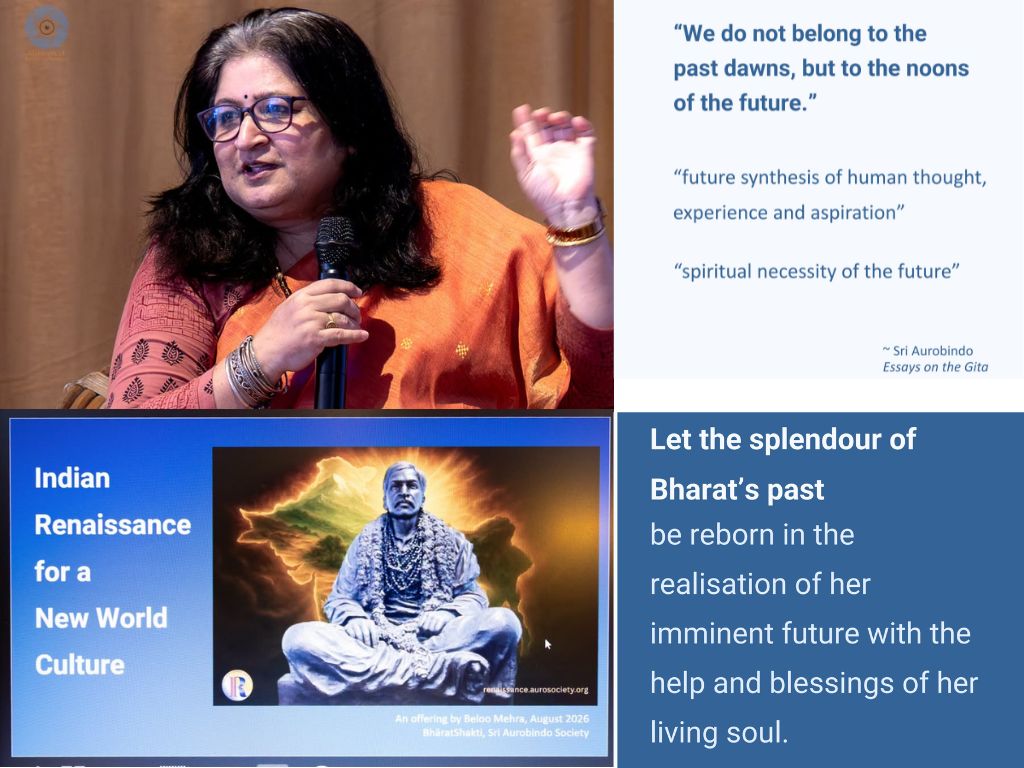
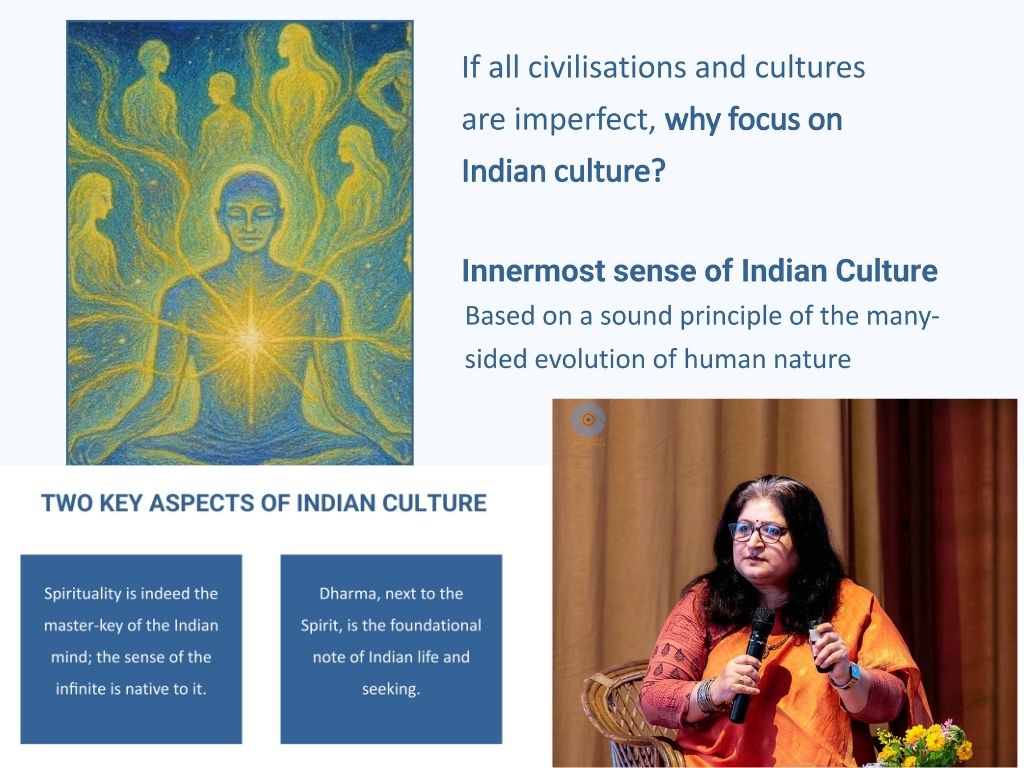
Another important thought highlighted during Dr. Mehra’s talk was that Sri Aurobindo has said that each civilization has made important contributions to the overall human march, yet human civilization in total remains largely unfinished because human nature has not been developed in an integrated way.
In this regard, Indian cultural renaissance has much to offer because the deepest guiding principle behind Indian cultural worldview encourages many-sided evolution of human nature. Here intellectual freedom supports spiritual seeking instead of conflicting with it, and diversity of perspectives is a natural consequence of the all-inclusive approach to spirituality. The two defining foundations of Indian culture are spirituality—the Indian mind’s native sense of the infinite—and dharma, the organizing principle of life and aspiration. India’s religious culture consequently developed unusual breadth, durability, subtlety, and openness to diverse paths while aspiring beyond fixed creeds.
The envisioned new world culture is neither consumerist monoculture nor a superficial fusion, but a fuller synthesis of humanity’s advances in matter, life, and mind with spiritual light, consciousness, and inner growth. India can contribute by correcting obsolete methods, removing barriers that once protected but later confined its spiritual ideal, and applying ancient knowledge with new illumination to humanity’s unresolved problems.
Recording of the talk will be available soon.
For more on related themes, read Preeti Mahurkar’s Blog series on our website – Fulfilling Sri Aurobindo’s Dreams: A New India Rising