
Date: March 24, 2026
Venue: Online
For thousands of years, Rāmāyana has been a living literary and cultural tradition of our land. It also went beyond the land of Bhārat and captured the cultural imagination of many parts of South-east Asia. A wider view of Indian socio-cultural milieu suggests that Rāmkathā continues to thrive as an important influence on collective Indian psyche despite the outer hybridity in collective Indian mental and cultural landscape.
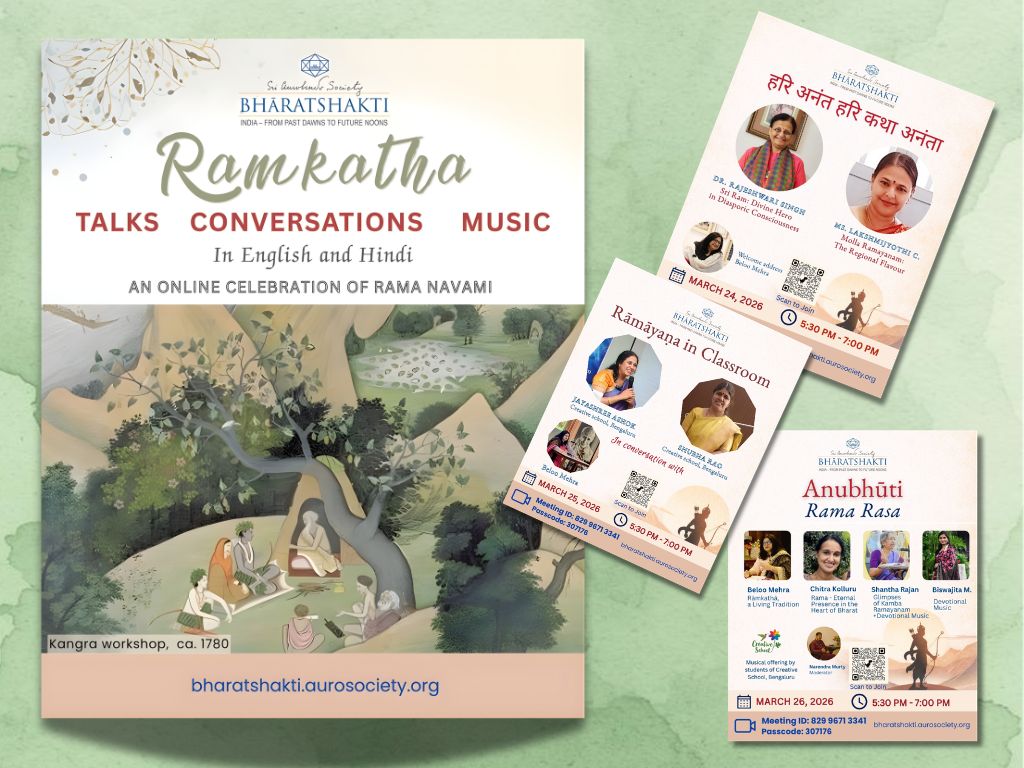
From March 24 to March 26, 2026, BhāratShakti organised a 3-day online programme to mark the Ramanavami celebrations. The programme included talks in English and Hindi, conversations and devotional music. It was inspired by Rishi Vālmiki’s words from the Rāmāyana:
“As long as the mountains and rivers flourish on the surface of the earth, so long the legend of Rāmāyana will flourish in this world.”
Day 1 – हरि अनंत हरि कथा अनंता
On Day 1, March 24, Dr. Rajeshwari Singh, President of Sri Aurobindo Sadhana Kendra, Vallabh Vidyanagar, Gujarat and Ms. Lakshmijyothi C., an independent scholar in Sri Aurobindo Studies from Pondicherry were invited to speak.
Dr. Beloo Mehra, Director of BhāratShakti, Sri Aurobindo Society and Editor, Renaissance welcomed all the participants in the webinar. In her introductory remarks she said that Ramkatha has travelled throughout India and even across India, and the 3-day programme is a celebration of this living tradition of telling, hearing, singing, and performing the story of Rama.
Dr. Mehra pointed out that Ramayana and Mahabharata are classified in the category of itihāsa which means – thus it happened. Or Thus it was. She explained that Sri Aurobindo explains the literary genre of Itihāsa as an ancient historical or legendary tradition which where a significant tale that expresses some spiritual or religious or ethical or ideal meaning is “turned to creative use” with a specific intention of forming the mind of a people.
So in that sense Valmiki [and Vyasa] saw themselves as architects and sculptors of life, creative exponents, and shapers of significant forms of the national thought, religion, ethics and culture. This is why in Ramayana we see profound and wide and vibrant philosophical thought on life, religion and society, and most of all on human conduct and choices. They have given the humanity much to learn and imbibe.
She gave a brief historical account connected to many retellings of Ramayana in Sanskrit as well as various Indian languages which fulfilled a cultural necessity by transferring into the popular speech of various regions the central story of Valmiki’s original epic poem. Some of these retellings highlighted selected episodes from the original, others added regional variations and made the story more relatable to the people in that region. These retellings across India in different languages helped unite the Indian collective consciousness in an organic and deeper way, Dr. Mehra pointed out.
The first invited talk of the day was delivered by Dr. Rajeshwari Singh who spoke on the subject of ‘Sri Ram: The Divine Hero in Diaspora Consciousness’. She based her remarks on what she saw amongst the Indian diaspora in Fiji and Samoa where she lived and worked for about six years. She briefly narrated how Indians reached those islands about 150 years back as indentured and cheap labour. Showing a picture of the Sitaram temple built by the indentured labourers who travelled to Fiji, she pointed out that it is important to remember that these people carried with them the culture and religion of Bharat, particularly their love for Ramayana, and their devotional music and dance performances inspired by Ramayana.
Pointing out that the descendents of those indentured labourers carry on the tradition of Ram Bhakti through their kirtans and satsangs. She related her experience in Samoa where Ramanavami and Hanuman Jayanti celebreated with the same kind of fervour and devotion amongst the diaspora Indians. She gave several examples to illustrate how the Maryada Purushottam Sri Ram is considered by the diaspora community as an ideal to follow – the loyal son, the devoted husband, the ideal king, the faithful friend and even a graceful enemy.
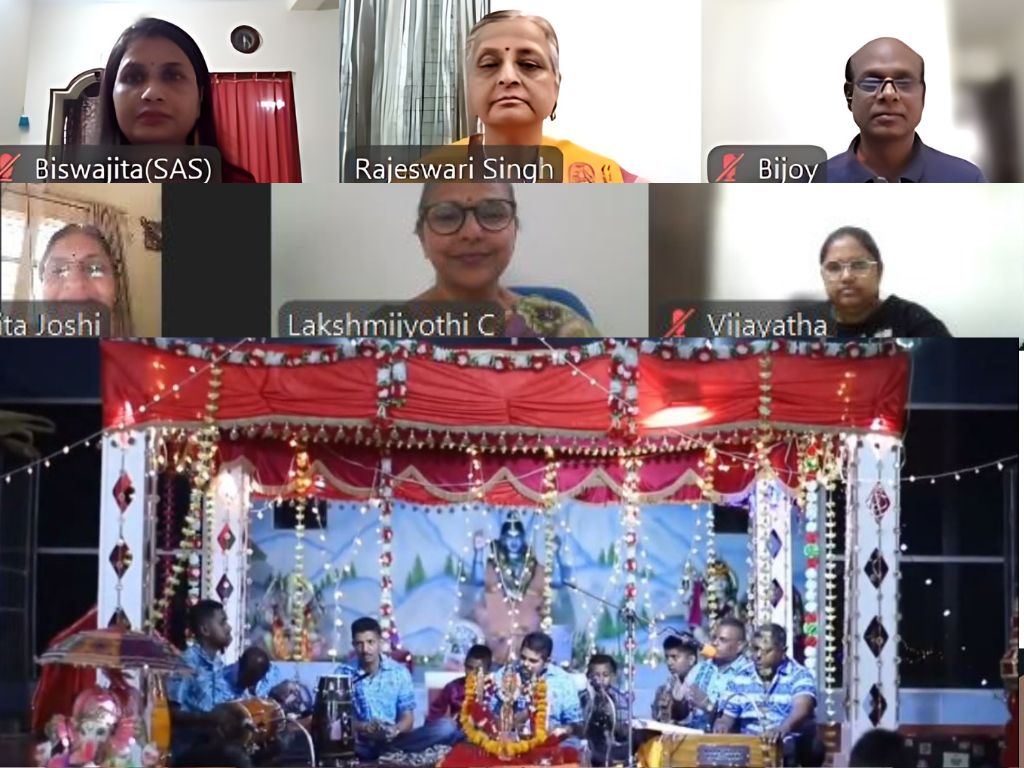
Dr. Singh pointed out that the diaspora could go through the alienation of staying in a remote foreign land because they carried in their heart the story of the exile of Sri Ram, Sita and Lakshman to inspire them. They belonged to different states from India but the one bond of unity that held them together was Ram Bhakti and that is what helped them to preserve and protect their culture, tradition and way of life.
She said that for the early indentured labourers Sri Ram became their deepest anchor while they lived in the midst of great hardship and dreamt of a better future. Their descendants, many of whom have never set foot on Indian soil, continue to revere Sri Ram with the same intensity, and because Prabhu Ram is in their hearts their love for Bharat remains unshaken. She concluded her presentation with a couple of short videos of the Fiji Indians performing Ram bhajan and Ram Lila.
Ms. Lakshmi Jyoti C spoke on the topic “Molla Ramayanam: The Regional Flavour”. Emphasising that the diverse languages of India reflected the soul of the nation she talked about how during the Bhakti movement saints from different regions of India spoke and sang in their languages and raised the consciousness of the masses. This is why Ramayana’s retellings in the diverse languages are so important and endearing to us.
Her talk then focused on Kummari Molla, the woman poet who wrote the Ramayana in Telugu which has the flavour of the jasmine flower. Ms. Lakshmijyothi said that though Valmiki at times humanises Rama, Molla’s approach throughout is that of a Bhakta because Rama was God to her. To give an example, she cited the instance where in Valmiki’s Ramayana, Rama cries and laments when Sita is abducted by Ravana, in Molla’s Ramayana all that crying is attributed to Lakshmana whereas Rama remains serene in that hour of distress.
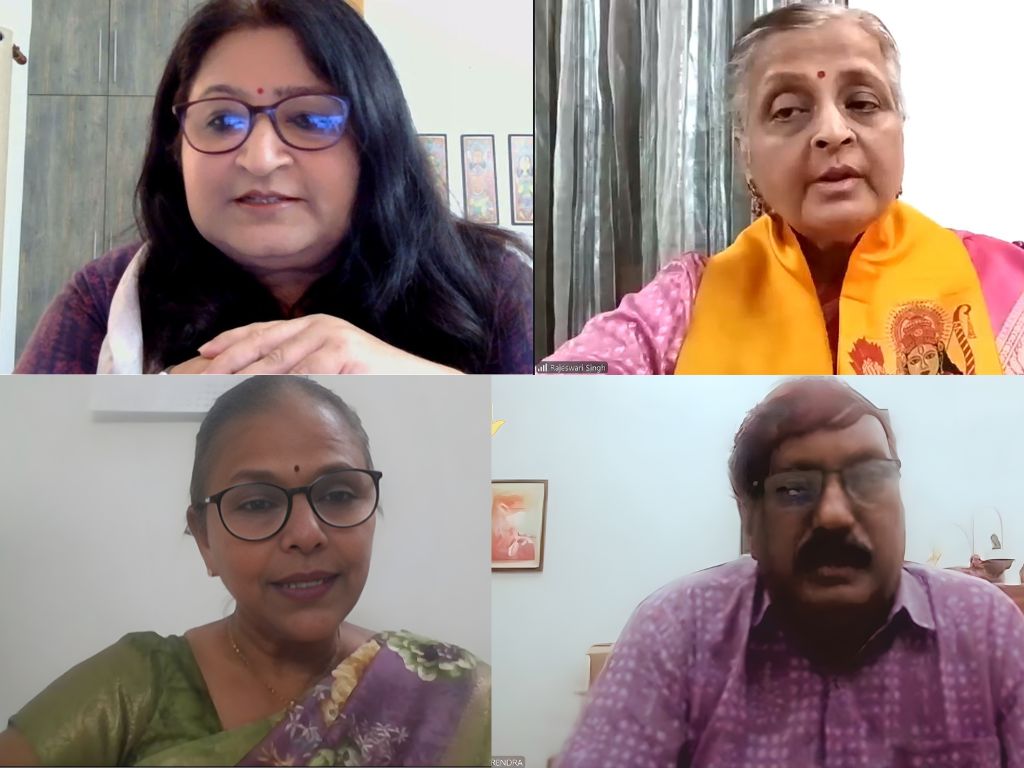
Ms. Lakshmijyothi emphasised that Molla’s Ramayana was not a translated version of Valmiki’s original but her own poetic rendition where she poured out her own heart and devotion. Thereafter she shared a few biographical details of Molla. She read out a few passages in Telugu from Molla’s work which roughly translate as:
If you really put your heart and listen Ramacharita manas is ever new;
It brings together so many fine qualities, it is verily like the Vedas;
Am I crazy to write Ramayana if it did not have these qualities?
Then again:
Whether you know or do not know what Valmiki had written is not important;
What is of importance is the Bhakti, you are blessed.
The reason why we read Ramayana is for Bhakti, not knowledge.
And:
In their brightness, they are like the moon
In appearance they are like the God of Love
In their generosity they are like the ocean
In their valour they are like the lions
In their glory they were like the sun
The princes of Ayodhya….
Both the talks were highly appreciated by the participants. Dr. Beloo Mehra expressed why she was keen on the Molla Ramayana because she was the only female poet of Ramayana. She shared some insights from Sant Tulsidas’ Ramcharitmanas as well. Thereafter, the session came to end after a short interaction with the participants.