Date: January 7, 2026
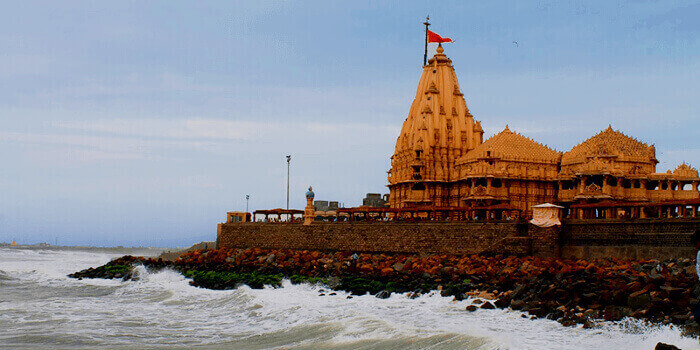
The year 2026 marks thousand years of the first attack on the Somnāth Temple at Prabhas Patan by Mahmud of Ghazni. The temple went through 17 brutal attacks at the hands of invaders and haters of Sanatana Dharma. But every time there was an attack there was also a strong resistance and a rebuilding. This latter truth is generally not taught in our history textbooks, nor is taught the history of reconstruction of this temple after Indian independence in 1947.
In addition to Sardar Vallabhbhai Patel, another important person involved in this project of great cultural significance was K. M. Munshi, who was a student of Sri Aurobindo at Baroda. K.M. Munshi, well-known as a freedom fighter, political thinker, lawyer, literary figure, institution-builder, and a great patron of Indian culture and civilisation, owed it all to Sri Aurobindo who inspired him to work for the renaissance of India and for the renewal of her eternal and noble traditions, unsullied by ritual and dogma.
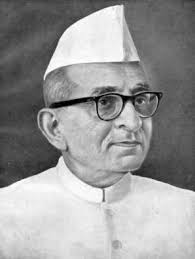
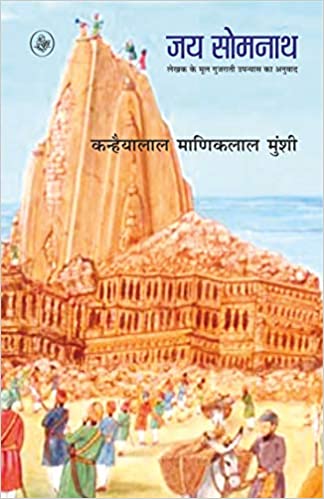
Munshi had done a good deal of historical research on the Somnāth temple. In addition to a historical novel titled Jaya Somnāth, he wrote Somnāth: The Shrine Eternal which was published on the occasion of the installation of the Somnāth deity in the newly constructed temple. In this he has given the detailed history of the temple; he described the deep anguish he felt when he first visited the ruins of Somnāth temple in 1922 in these words:
“Desecrated, burnt and battered, it still stood firm – a monument of our humiliation, and ingratitude. I can scarcely describe the burning shame which I felt on that early morning as I walked on the broken floor of the once-hallowed sabha mandap, littered with broken pillars and scattered stones. Lizards slipped in and out of their holes and the sound of my unfamiliar steps, and Oh! The shame of it! – an inspector’s horse, tied there, neighed at my approach with sacrilegious impertinence.”[i]
Given the great historical, cultural and spiritual significance of this temple and the geographical area of Prabhas Patan in the collective psyche of Indians, after independence, both Munshi and Sardar Patel strongly felt that restoration of the temple to its glory would significantly enhance the faith of Indians in their future as a free people. Munshi was invited by Sardar Patel to draw up a plan for this important task. Unfortunately, Munshi’s contribution towards the rebuilding of the Somnāth temple and the challenges he faced during that time are not common knowledge for most Indians.
After the accession of Junagarh to India in October 1947 a decision was made to reconstruct the Somnāth temple. Sardar Patel had made this public announcement during his visit to Prabhas Patan. But there was some resistance in the union cabinet back in Delhi. Maulana Abul Kalam Azad, the education minister at that time and a good friend of Jawahar Lal Nehru, opposed the idea. He argued that the temple ruins should be handed over to the Archaeological Survey of India (ASI), to be preserved as a historical monument. Interestingly, Maulana Azad had never suggested anything similar for Islamic shrines and mosques which were being repaired by the ASI at that time.
Sardar Patel was very firm in his resolve to see the temple restored to its glory; he responded with a note:
“The Hindu sentiment in regard to this temple is both strong and widespread. In the present conditions, it is unlikely that this sentiment will be satisfied by mere restoration of the temple or by prolonging its life. The restoration of idol would be a point of honour and sentiments with the Hindu public.”[ii]
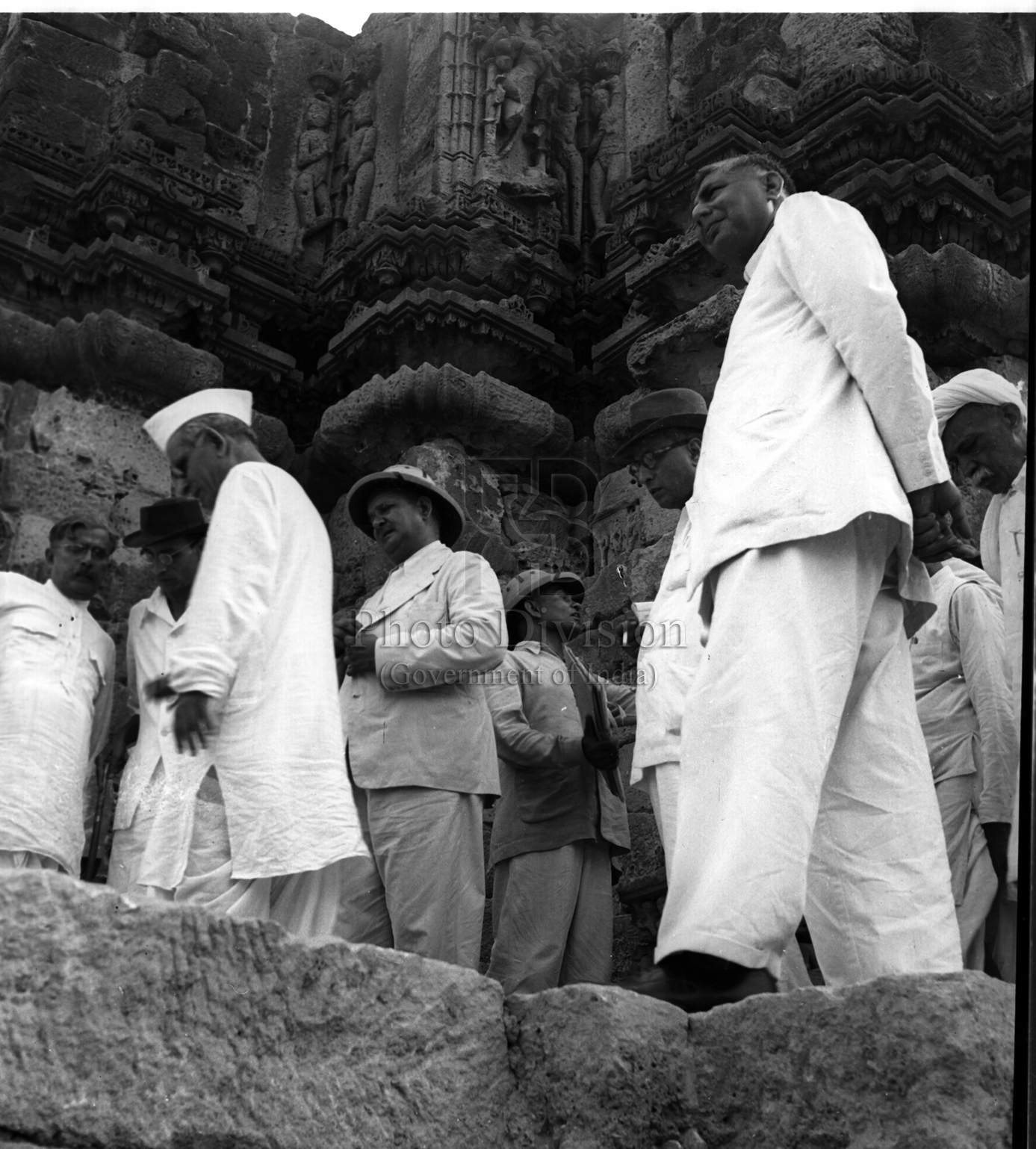
The temple was not going to be preserved as a historical monument; it was going to be reborn as a living temple, restored to its old glory as the first among the 12 jyotirlinga-s of India. The temple complex was going to be developed as a major pilgrimage centre and a place of great cultural and spiritual significance.
Nehru presided over the cabinet meeting in which this decision was taken. But after Sardar Patel’s passing in December 1950, it seems Nehru became very hostile, not only to the temple project, but also to his cabinet colleagues, particularly Munshi and V. N. Gadgil, who were associated with the temple reconstruction project.
The President of India, Dr. Rajendra Prasad was requested to inaugurate the ceremony of the prāna-pratishthā (installation of deity). But while preparations for the big event were going on, Nehru called Munshi and said, “I don’t like your trying to restore Somnath. It is Hindu revivalism.” Munshi felt humiliated, the more so because Nehru made it seem as if things were being done without his knowledge.
On April 24, 1951, Munshi wrote a long letter to Nehru clarifying many things and giving a detailed account of the government’s decisions taken during the entire reconstruction process. The letter is an important historical document not only for its thoroughness, but also because many aspects related to the rebuilding of the Somnāth temple would have remained completely unknown if Munshi had not written this letter. A few excerpts from the letter are given below:
“As you will see, the Government of India not only took the initial decision to reconstruct the temple, but formulated and set the scheme going; alongside creating the agency for its further implementation. This will clearly indicate to you the extent of association the Government of India has with the scheme…
“Yesterday you referred to ‘Hindu revivalism.’ I know your views on the subject; I have always done justice to them; I hope you will equally do justice to mine. Many have been the customs which I have defied in personal life from my boyhood. I have laboured in my humble way through literary and social work to shape or reintegrate some aspects of Hinduism, in the conviction that that alone will make India an advanced and vigorous nation under modern conditions…
“One word more. It is my faith in our past which has given me the strength to work in the present and look forward to our future. I cannot value freedom if it deprives us of the Bhagavad Gita or uproots our millions from the faith with which they look upon our temples and thereby destroys the texture of our lives. I have been given the privilege of seeing my incessant dream of Somnath reconstruction come true. That makes me feel — makes me almost sure — that this shrine once restored to a place of importance in our life, will give our people a purer conception of religion and a more vivid consciousness of our strength, so vital in these days of freedom and its trials….”[iii]
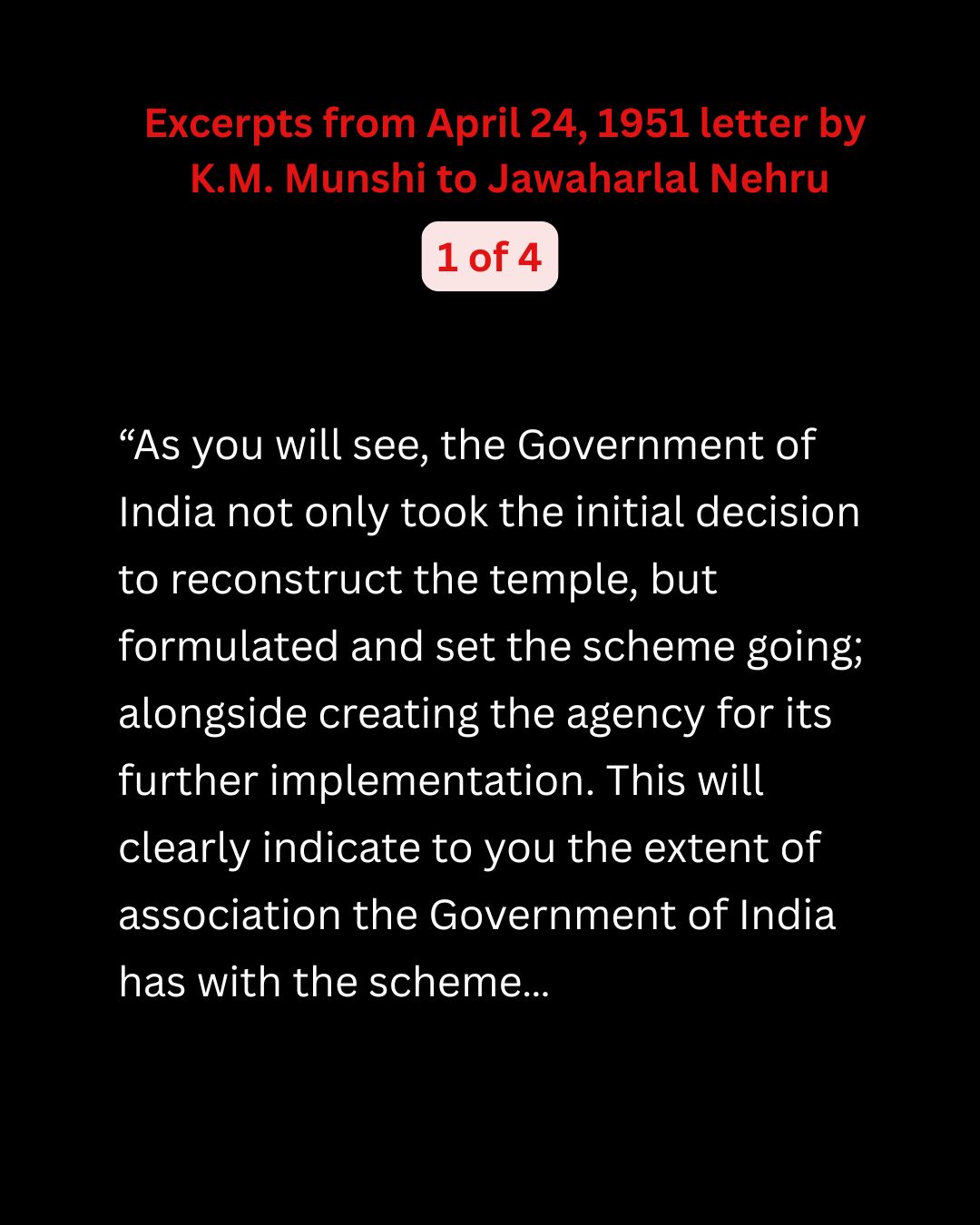
This marvellous letter expresses both the force and sincerity of Munshi’s words; no wonder it was called a ‘masterpiece’ by V.P. Menon, one of the key advisors in Nehru’s cabinet. Despite Nehru’s strong disapproval and opposition, the President of India, Dr. Rajendra Prasad, went on to inaugurate the prāna-pratishthā ceremony. Without the courage and conviction of Munshi, the Somnāth temple would have not been built, period.
But there is one more significant piece of history that shines greater light on these outer events. A few months before writing his ‘masterpiece’ letter to Nehru, on July 30, 1950, Munshi had written to Sri Aurobindo:
“I would like to have your guidance as regards the future of Sanātana Dharma. Starting from your Uttarpara Speech, which has been a sort of beacon to me for years, I have been working for the reintegration of Hindu culture . . . But I am neither learned nor a profound thinker. I can contribute only my faith and the little energy which has been vouchsafed to me. I only pray that strength may be given to me to carry forward the message of the Seers of whom, in my opinion, you are the only surviving Apostle. What shall I do now?”[iv]
It is quite telling that Munshi in his letter quoted the lasting impact Sri Aurobindo’s Uttarpara speech had had on him and the work that he had been doing in various capacities. Delivered on May 30, 1909 at Jaykrishna Public Library in Uttarpara, Bengal, this speech is perhaps one of the most important speeches in modern India’s spiritual as well as political history. It was the first time when Sri Aurobindo spoke of his inner spiritual realisation, especially how the truth of Sanatana Dharma was revealed to him by Sri Krisna in the prison. And at the same time in this speech, he laid out the broad lines on which future Indian nation must be built so that it remains true to India’s eternal spirit and inner genius.
The following reply from Sri Aurobindo was sent to Munshi on August 3, 1950, dictated to A.B. Purani:
“My dear Kanubhai,
“In reply to your letter to him of July 30th, 1950 Sri Aurobindo has asked me to write to you the following:
“Your feeling that there should be reintegration of Indian Culture under modern conditions is quite right. It is the work that has to be done. And as far as Sri Aurobindo can see at present Indian Spiritual Culture has a great and bright future before it. It is the future power that might dominate the world. So, your efforts in carrying out that work are quite in the right direction and in carrying out that work you would have his full support and blessings.”[v]
Munshi’s efforts towards reconstruction of the Somnāth temple were indeed blessed by Sri Aurobindo. His words in this letter of August 3, 1950 gave spiritual force and moral strength that Munshi needed to stand firm on his decision and resist the opposition which was trying to halt the reconstruction and demean its deeper significance for the soul of India by reducing it as mere religious revivalism. One needs to read Sri Aurobindo’s writings on Indian culture, starting with Uttarpara speech to know the true essence of Hinduism or Sanatana Dharma, the foundation of Indian Spiritual Culture, and the necessity of its reintegration under modern conditions. This speech also helps us appreciate the Dharmic light in which the essential Indian national identity must be shaped.
Notes
[i]K.M. Munshi, Somnāth – The Shrine Eternal, 1951 (3rd edition 1965), pp. 163–164.
[ii] K.M. Munshi, Pilgrimage to Freedom, 1967, p. 560.
[iii] K.M. Munshi, Somnāth – The Shrine Eternal, 1951, pp. 176–178.
[iv] Sri Aurobindo, CWSA, Vol. 36, p. 512–513
[v] ibid, p. 513
WATCH:
Sri Aurobindo’s Uttarpara Speech:
Its Timely and Timeless Significance