
Date: March 26, 2026
Venue: Online
Watch the Recording
From March 24 to March 26, 2026, BhāratShakti organised a 3-day online programme to mark the Ramanavami celebrations. The programme included talks in English and Hindi, conversations and devotional music.
Day 1 focused on the theme: Ram-bhakti, Diasporic Consciousness and Cultural Continuity. Read the report of Day 1 programme HERE.
The second day focused on the theme ‘Ramyana in the Classroom’ and featured an engaging interaction with two educationists from Creative School, near Bengaluru. Read the report of Day 2 programme HERE.
Day 3 – Anubhuti: Rama Rasa
The final day’s event wrapped up the 3-day Ramanavami celebration with talks on Ram Katha as a living tradition, Rama’s eternal presence, Kamba Ramayanam glimpses, and devotional anecdotes, fostering bhakti through art, music, and stories.
After a brief silent concentration invoking the Divine Presence, Mr. Narendra Murty, Research Associate, BhāratShakti, invited the first speaker of the day, Dr. Beloo Mehrawho spoke on the subject “Ram Katha: A Living Tradition”.She reminded the audience that Sri Aurobindo has explained that the purpose of Rama’s avatarhood as the establishment of a new Dharma of the Sattwik mind in the evolutionary consciousness of humanity. And this work has been done in a living manner through the dissemination of the Ramkatha over thousands of years. The tradition has been kept alive through the retelling and recreating of the story of Rama by many inspired poets going beyond Valmiki.
Dr. Mehra shared that over the centuries there have been several schools of painting all across India which have illustrated episodes of Ramayana through paintings. She showed a copy of one such modern Illustrated Ramayana along with some pictures from the same to give an impression how the story has been recreated. Not only Valmiki’s Ramayana but even Tulisidas’s Ramacharitmanas has been illustrated.
She spoke briefly about one such project based on thousands of paintings done in 18th century in Banaras which were compiled in a massive seven volume work called the Kanchana Chitra Ramayana – The Golden Illustrated Ramayana. Some actual pictures from that a book based on these paintings were also shown. Dr. Mehra also mentioned how at Kalakshetra, Chennai they have used the art of Kalamkari of Andhra Pradesh to illustrate Ramayana and its stories and also using English as a language for explaining the narratives.
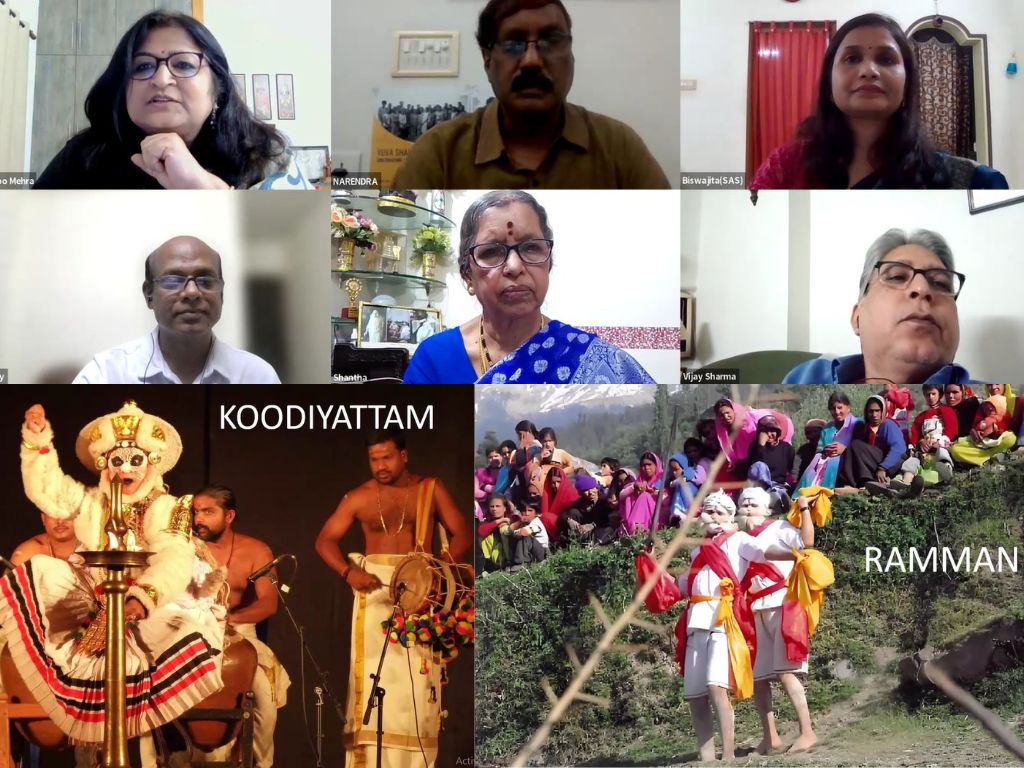
Dr. Mehra then shared some examples of how Ramkatha has been portrayed through performing arts all across India. She showed several visuals depicting how Ramkatha is performed through dance and theatres in places as diverse as Delhi, Goa, Uttarakhand, Himachal Pradesh, Karnataka, Tamil Nadu and Kerala along with the names of each art form that is practiced in those places. Many of these theatrical traditions have been recognised by UNESCO as Intangible Heritage of Humanity.
To facilitate the anubhuti of Rama Rasa, a few short video clips were also played which showcased traditional Ramlila performance in Ujjain, a Sri Ram Bhartiya Kala Kendra production from Delhi and then a Kalakshetra dance drama performance from Chennai. Dr. Mehra added that in so many ways Ramayana has been celebrated over the ages in various art forms, including cinema and television. She mentioned how the famous Ramanand Sagar’s version of Ramayana became an instant hit once again during the Covid period when it was aired again on television. That shows how the Ram Katha – the story of Rama has an eternal and enduring appeal for the Indian mind and heart.
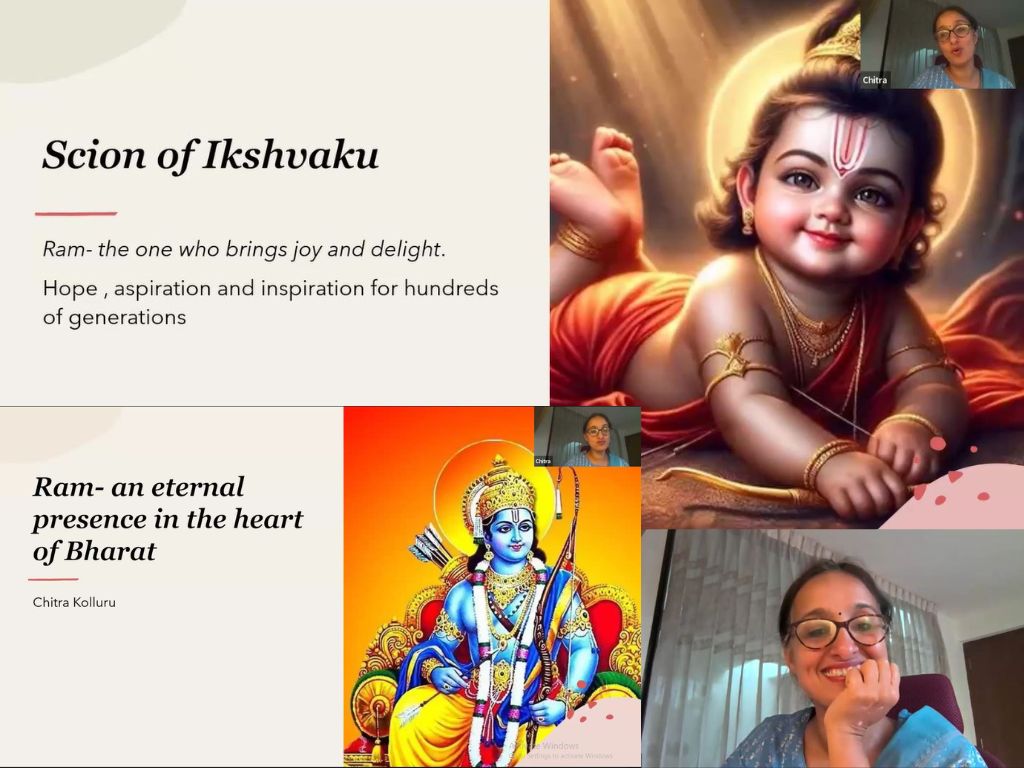
The next speaker of the day was Ms. Chitra Kolluru who spoke on the subject “Rama – An Eternal Presence in the heart of Bharat.” Starting with the birth of Rama and briefly recounting his years of growth, she briefly mentioned how the character of Rama developed and ultimately became a religious, spiritual and cultural icon and how his influence continued to spread for centuries, not only across the length and breadth of India but even beyond the national borders to the entire South East Asia. That became possible because people found deep inspiration in the ideal of Rama, particularly his selfless love, kindness and benevolence not only towards his own near and dear ones but to all human beings, even to animals and his enemies.
Ms. Kolluru said that another aspect of Rama’s personality which makes him an abiding presence in the heart of India is the way he embodied the warrior spirit of courage but without any hatred and malice. He also stands as the highest ideal for right governance, the Ram Rajya, and one who can give perfect leadership for the society. Rama demonstrated freedom from all prevailing social conventions when he ate the fruits from Sabari, a woman belonging to a lower jati. He represents the Sattwik age of human evolution by overcoming the Rakshasa (the egoistic mind) and Vanara (the animal mind).
Ms. Kolluru expressed her opinion that Ram should not remain confined to Ramkathas only but also needs to be brought into the classrooms, corporate boardrooms and war fronts. And that can happen only when we imbibe in ourselves the qualities of Sri Ram which can then find expression in all the spheres of life.
Ms. Shantha Rajan was the next speaker who spoke on the topic “Glimpses of Kamba Ramayanam”. She began with reciting a verse from the Kamba Ramayanam. She gave a short life sketch of Kamban emphasising that he was proficient in both Tamil and Sanskrit. He was a devout Bhakta who was deeply inspired by Valmiki’s Ramayana. Though inspired, his own composition in Tamil differed in many aspects from the original. She maintained that Kamba Ramayana was not a translation but rather a recreation of the epic with a distinct Tamil flavour.
Ms. Rajan gave some examples showing the points of divergence between Valmiki’s and Kamban’s Ramayan. For instance, in Valmiki’s Ramayana, Ram and Sita do not see or meet each other before the contest of lifting the bow of Shiva but in Kamban’s version, when Rama is walking through the streets of Mithila along with Vishwamitra and Lakshman, he sees Sita standing in the balcony of her palace and she too sees him and in the exchange of glances they become immediately attracted and start dwelling in the thoughts of each other.
In the episode of Sita’s abduction, Ravana does not touch Sita at all in the Kamba Ramayana. Also, the way Mandodari has been extolled throughout Kamba’s Ramayana, that kind of treatment is not found in Valmiki. The same applies to the characterisation of Surpanakha. Then again Kamban includes the story of Narsimha Avatar in his version of Ramayana because he had in his heart a special devotion towards Narsimha. This of course, has no parallels in Valmiki’s Ramayana.
By pointing out such differences between Valmiki’s original and the poetic recreation by poets like Kamban, Ms. Rajan made the point these were manifestations of different forms of Bhakti and how the Lord manifests himself differently and inspires each poet in his own way.
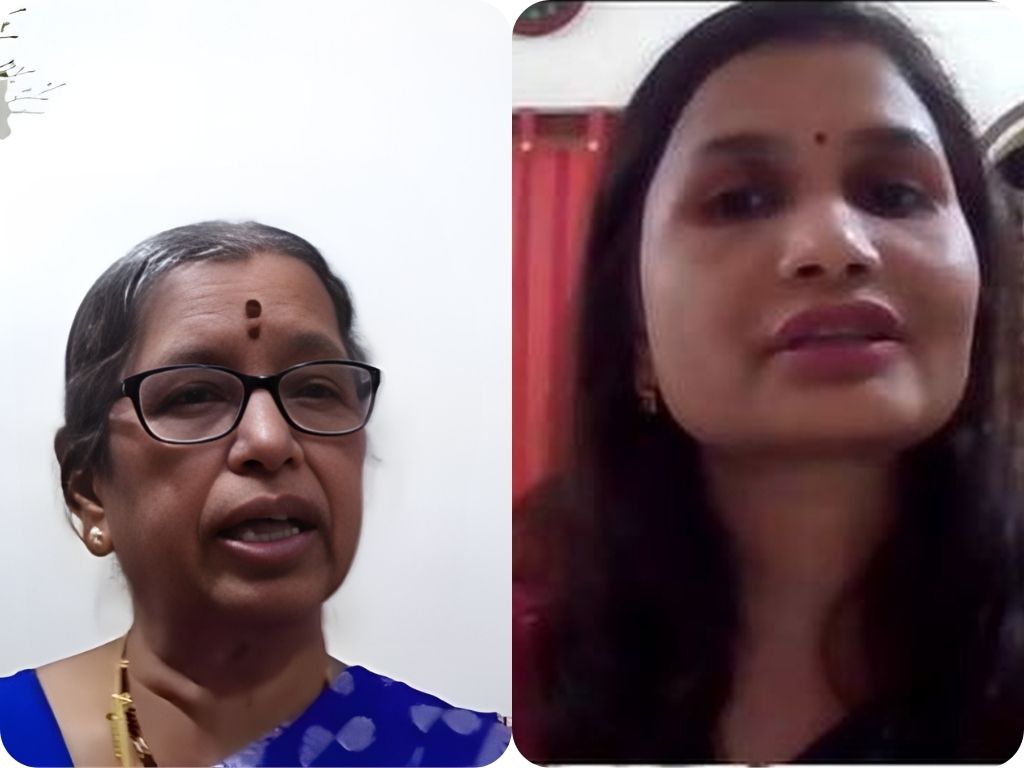
Thereafter, Ms. Biswajita Mohapatra narrated a delightful anecdote about the visit of Sant Tulsidas to Jagannath Dham in Puri, Odisha and how he was disappointed by not finding his Rama in the image of Jagannath. Then a wonderful boy appeared in his dream citing the poet’s own words where he described that God can do everything without the need for limbs and asked him to look again at the image of Jagannath. Next morning, Tulsidas was rewarded with a reflection of his beloved Ram in the image of Lord Jagannath. Ms. Mohapatra then rendered a beautiful Bhajan in Oriya whose theme was – He who is Jagannath, he is Rama, he is the one who reveals as Gita and so on.
The programme concluded with playing of two recorded musical renditions. One was Sri Ramastotram in Sanskrit by Shantha Rajan and the other offering was a Ram Naam Japa by the students of Creative School. The participants enjoyed the variety of topics taken up on all 3 days of the Ramanavami celebrations and appreciated the ambience of bhakti and shraddha created through such heartfelt offerings by all the presenters.