
Date: February 17, 2026
Venue: Sardar Patel University, Vallabh Vidyanagar, Gujarat
WATCH THE RECORDING
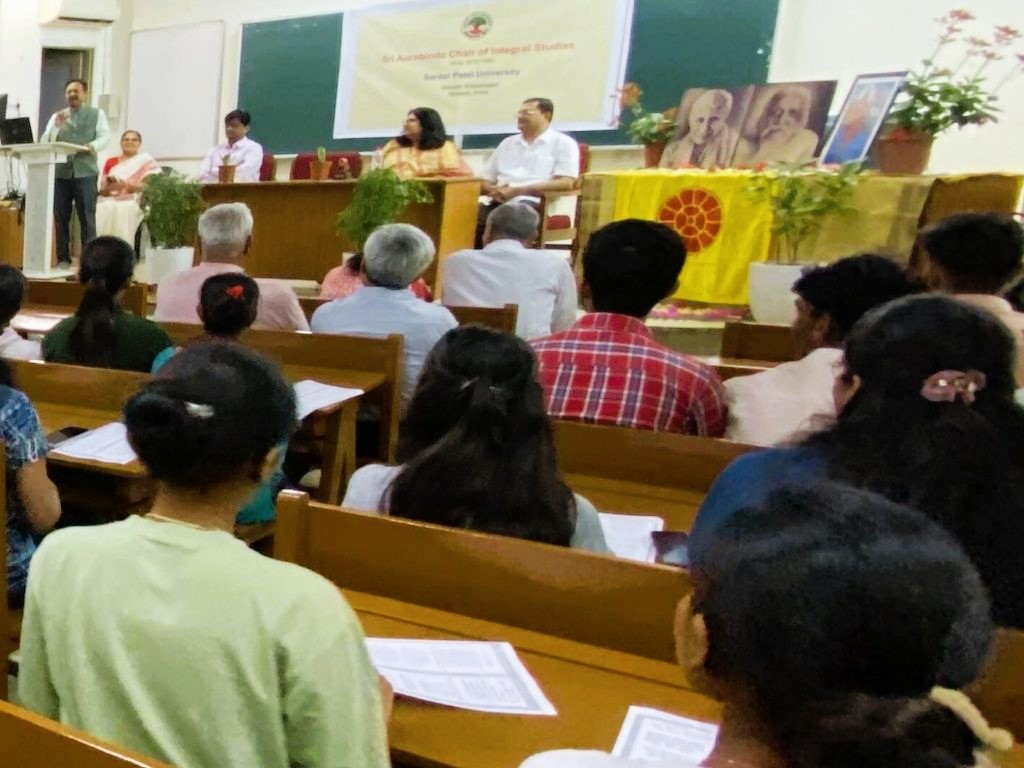
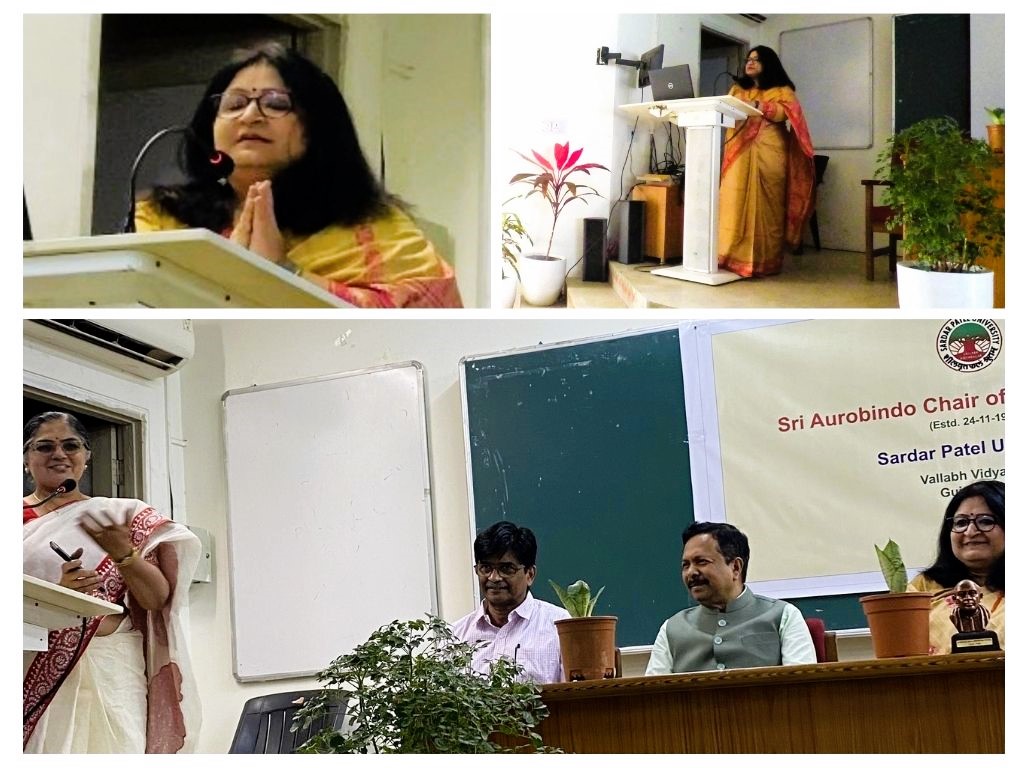
Sri Aurobindo Chair of Integral Studies, Sardar Patel University, Vallabh Vidyanagar in Gujarat invited Dr. Beloo Mehra, Director, BhāratShakti, Sri Aurobindo Society for the 2026 Shri A.B. Patel Memorial Lecture. The lecture-event held on February 17, 2026 at the Department of Biosciences, SPU and was presided over by Prof. Niranjan Patel, the Hon’ble Vice Chancellor of Sardar Patel University.
Other dignitaries present at the event included Prof. Bhalendu Vaishnav who currently holds the Sri Aurobindo Chair of Integral Studies at SPU, Prof. Vibha Vaishnav, Head, Dept. of Electronics, SPU (who was also the MC for the event), Dr. Ujjval Trivedi, Head, Dept. of Biosciencees, SPU, and Dr. Rajeshwari Singh, President, Sri Aurobindo Sadhana Kendra, Vallabh Vidyanagar. Several other faculty members from the university, invited guests and about 60 students also attended this special memorial lecture.
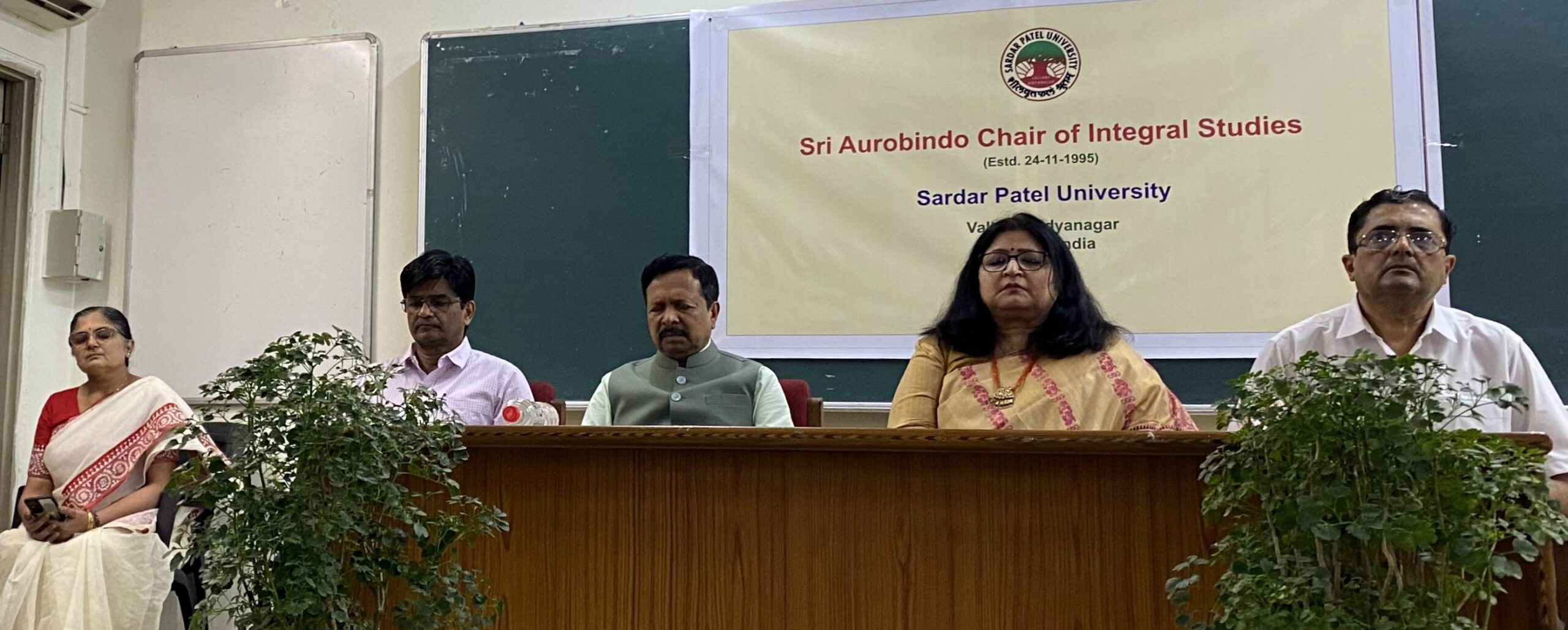
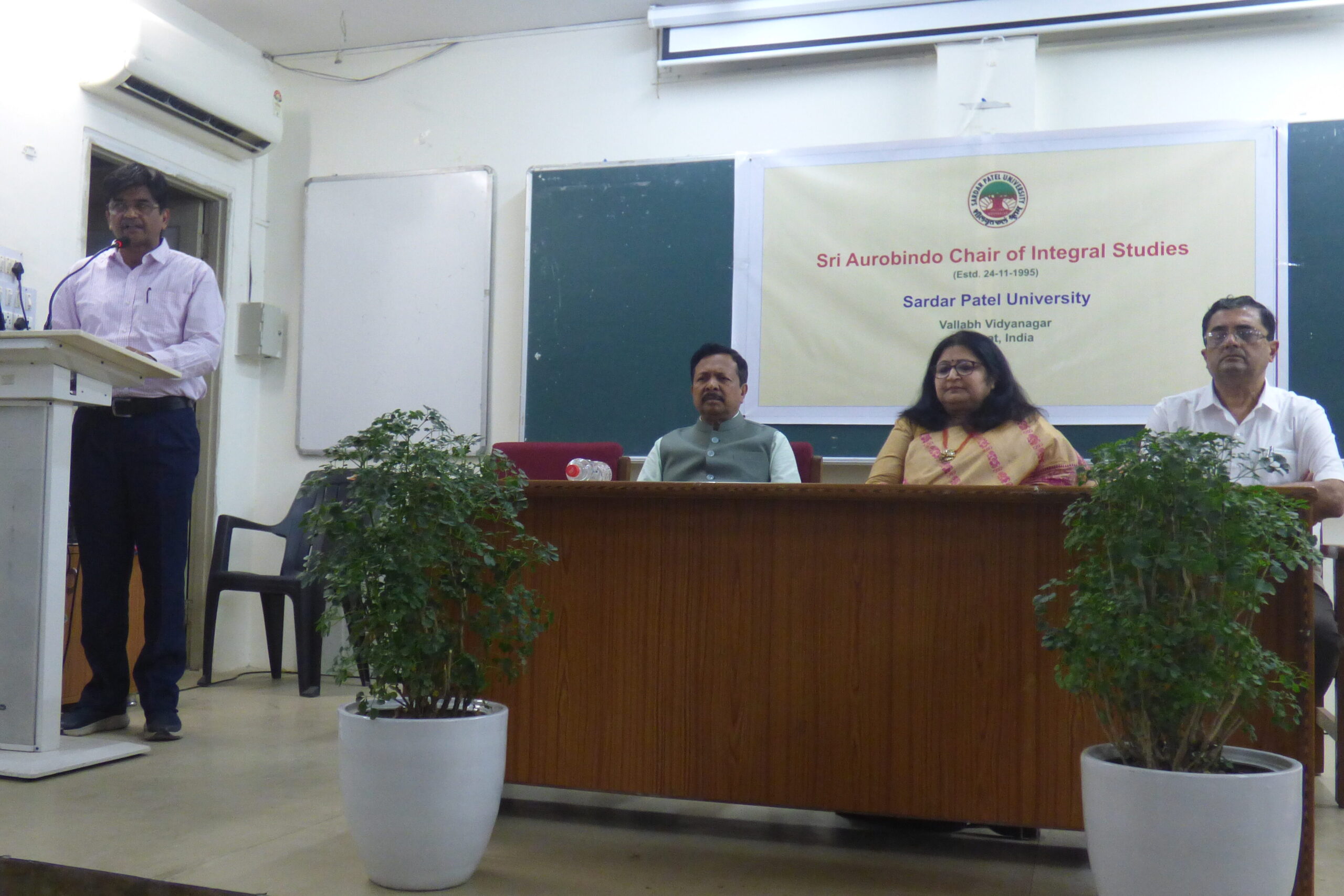
The programme began with a short music meditation invoking Divine Mother’s presence followed by a prayer to Mother India. Afer a brief welcome address given by Dr. Ujjwal Trivedi followed by Dr. Bhalendu Vaishnav in introductory remarks spoke on the significance of the theme of the lecture, especially in the context of the ongoing nation-wide celebrations of the 150 years of Vande Mataram – India’s National Song penned by Bankim Chandra Chatterji, and its call for a resurgent shakti of Bharat. Dr. Beloo Mehra was then invited to deliver the Shri A. B. Patel Memorial Lecture.
Dr. Mehra began her lecture by thanking the Hon’ble Vice Chancellor for his gracious presence and the office of Sri Aurobindo Chair of Integral Studies for inviting her to deliver the Memorial Lecture on this very important and timely theme. She opened her remarks by saying that this theme is at once historical, cultural, and spiritual: Vande Mataram—“Mother, I bow to thee”—is a mantra that awakened an entire people and helped shape the soul of Indian nationalism.
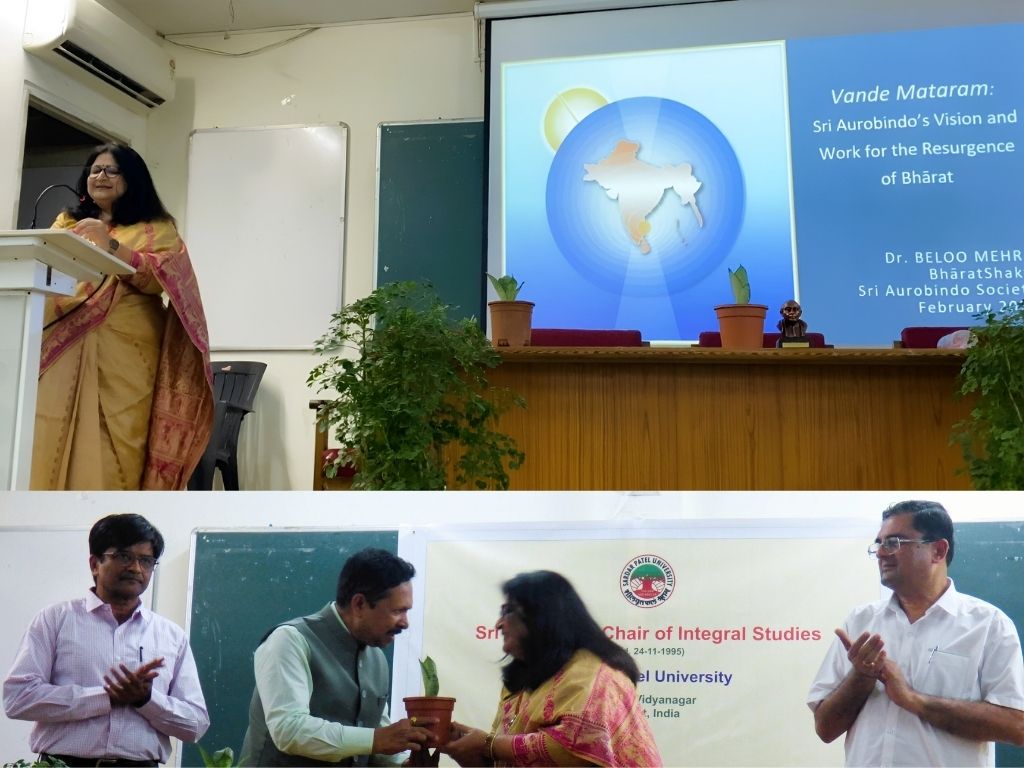
She said that through her lecture she would like to explore a bit of the history about this song and how it became a mantra for Bhārat’s awakening and resurgence. Dr. Mehra added that it is important to recognise how Sri Aurobindo infused a new spiritual force into this mantra and gave us the vision of spiritual nationalism. It is important that the youth today must be invited to reflect on the significance of this ideal for future march of India, along with another important question – what does “Mother India” truly mean.
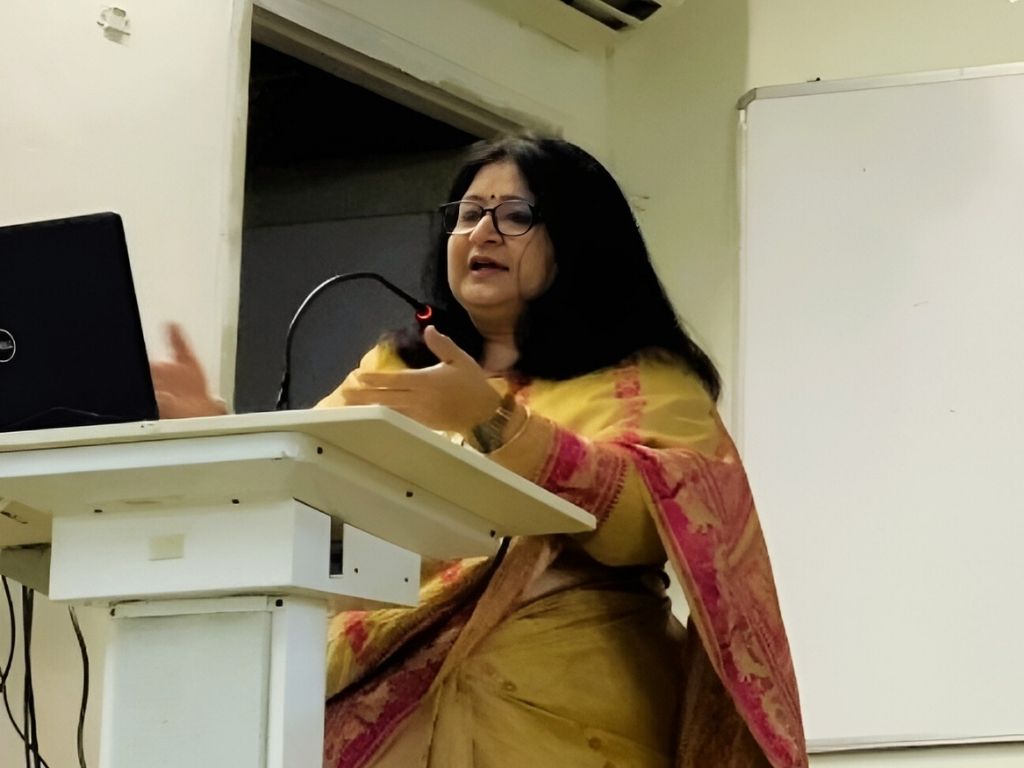
Dr. Mehra briefly spoke about Bankim Chandra Chatterjee who gave India the song “Vande Mataram” which became the reviving mantra of India during her freedom struggle. Sri Aurobindo recognized Bankim as “creator and king of Bengali prose,” and admired Bankim’s boundless intellect.
But Sri Aurobindo’s homage to Bankim goes deeper than literary praise, said Dr. Mehra. He called Bankim “the last of the original geniuses,” clarifying that originality does not mean rejecting outside influences but accepting them “as a new mould into which our own individuality may run.” He credited Bankim with having “created a language, a literature and a nation,” noting the transformation from “the earlier Bankim” as poet and stylist to “the later Bankim” as “seer and nation-builder,” whose works—from Krishna Charitra to Dharmatattva, Devatattva, and Srimadvagavat Gita—formed a high spiritual foundation for Indian renaissance.
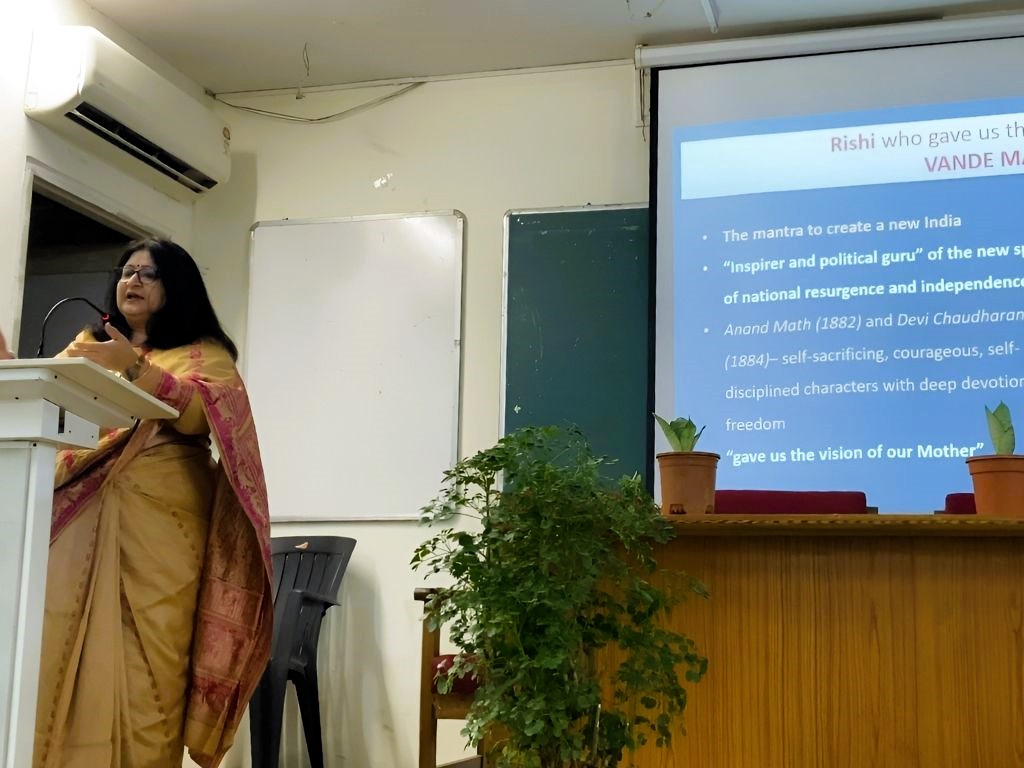
Dr. Mehra reminded the audience that Sri Aurobindo spoke of Bankim as a Rishi who gave the reviving mantra, VANDE MATARAM—“the mantra to create a new India.” He referred to him as “the inspirer and political guru of the new spirit of national resurgence and independence.” Through novels like Anand Math (1882) and Devi Chaudharani (1884), Bankim depicted self-sacrificing, courageous, and self-disciplined characters devoted to freedom. But his biggest service to the nation was giving us “the vision of our Mother.”
Dr. Mehra’s talk then explored Sri Aurobindo’s vision, spiritual nationalism, and the deeper meaning of India’s resurgence in the context of the mantra Vande Mataram. She highlighted Sri Aurobindo’s own English translation of Vande Mataram, a powerful poetic rendering that expresses love for the Motherland, her strength, beauty, and divine embodiment in Durga, Lakshmi, and the Muse. She briefly mentioned how the song inspired the youth at the freedom rallies, political gatherings and sessions, revolutionary movements in colleges and schools, and national symbols in the early twentieth century, becoming a rallying cry for India’s freedom struggle.
She then gave the audience a quick overview of Sri Aurobindo’s early political life, portrayed through images of him as an undertrial prisoner, described as a “poet of patriotism,” “prophet of nationalism,” and even “the most dangerous man” in the eyes of the British Empire. Dr. Mehra highlighted Sri Aurobindo’s political philosophy which emphasized the urgent need for Shakti—physical, moral, mental, and above all spiritual strength—as the one essential requirement for India’s regeneration. She also shared with the audience a bit about his letter to his wife where he spoke of his famous “three madnesses,” reflecting his intense love for the Motherland and spiritual calling.
Dr. Mehra spent some time outlining Sri Aurobindo’s contributions to the nationalist movement: demand for Purna Swaraj, non-cooperation, Swadeshi, national education, arbitration courts, and the formation of youth revolutionary groups. He saw passive resistance as a potent political force to challenge colonial rule.
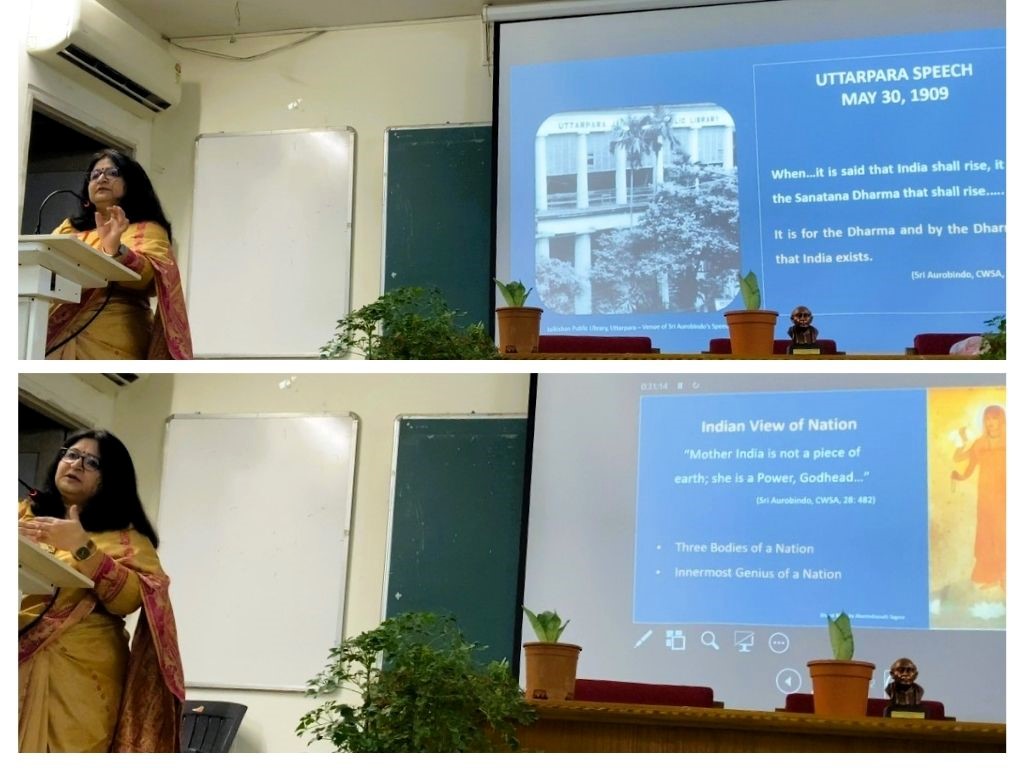
Dr. Mehra emphasised that Sri Aurobindo’s deeper philosophical vision presents Mother India as a living Power with three bodies—the physical land and people, the cultural-mental life, and the deeper causal temperament shaped across ages. All nations, he said, manifest the One Divine in many forms. True nationalism, for him, meant working toward the realization of divine unity, essential equality among individuals and social groups, and the rejection of any system—social or political—that denies this equality. A true nationalist, he insisted, must see himself as an instrument of God for the upliftment of the nation, acting in a religious spirit of dedication and self-surrender.
Reference was made to Sri Aurobindo’s Uttarpara Speech (1909) where he declared that India exists for the Dharma and will rise through the Sanatana Dharma and it is this universal dharma which must be offered to the world. This Dharma is an open, many-sided spiritual framework recognizing multiple paths to the Divine and the soul’s inward communion with the Eternal.
Dr. Mehra concluded her talk by highlighting Sri Aurobindo’s broader vision and mission for resurgence of India expressed through his writings in Karmayogin and his famous Five Dreams, envisioning a united India, Asian resurgence, world unity, India’s spiritual gift to humanity, and the evolution toward a divine life on earth.
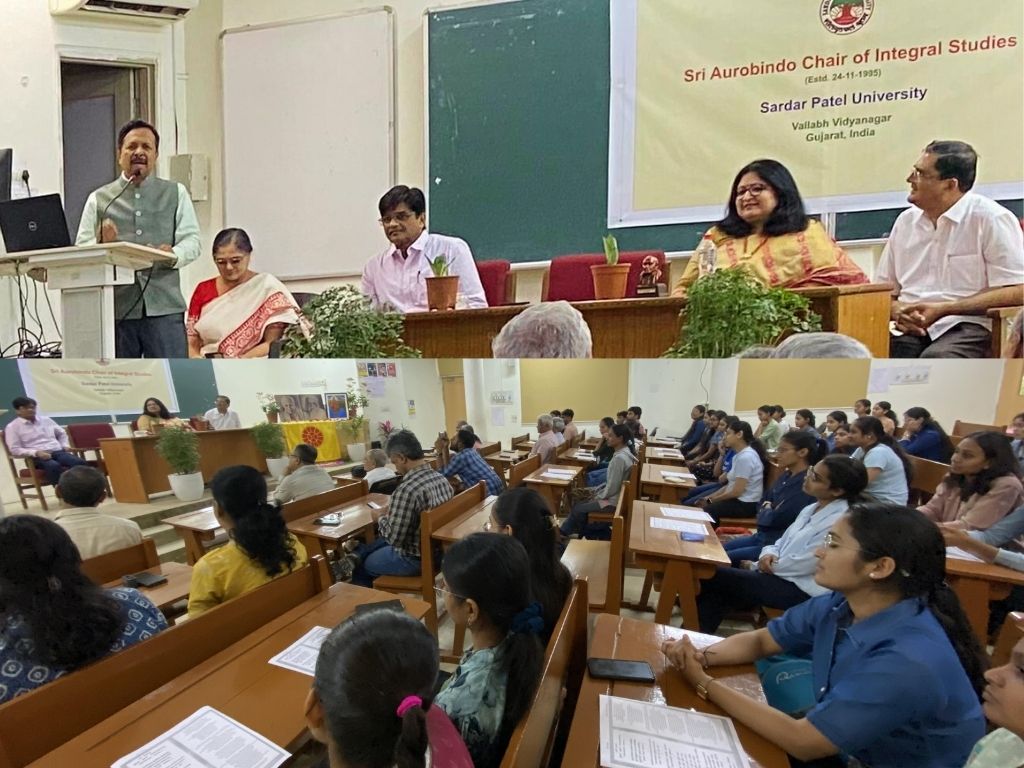
The lecture was appreciated by all. Prof. Niranjan Patel, Vice Chancellor of Sardar Patel University, congratulated Dr. Mehra for delivering a thorough lecture on an important topic. He also appreciated the office of Sri Aurobindo Chair of Integral Studies for organising this important event and for introducing the youth of India to these high ideals and a deeper spirit of love for the motherland. He reminded the students in particular of the need to learn about the history of Indian freedom movement and to dedicate themselves to working for Mother India.
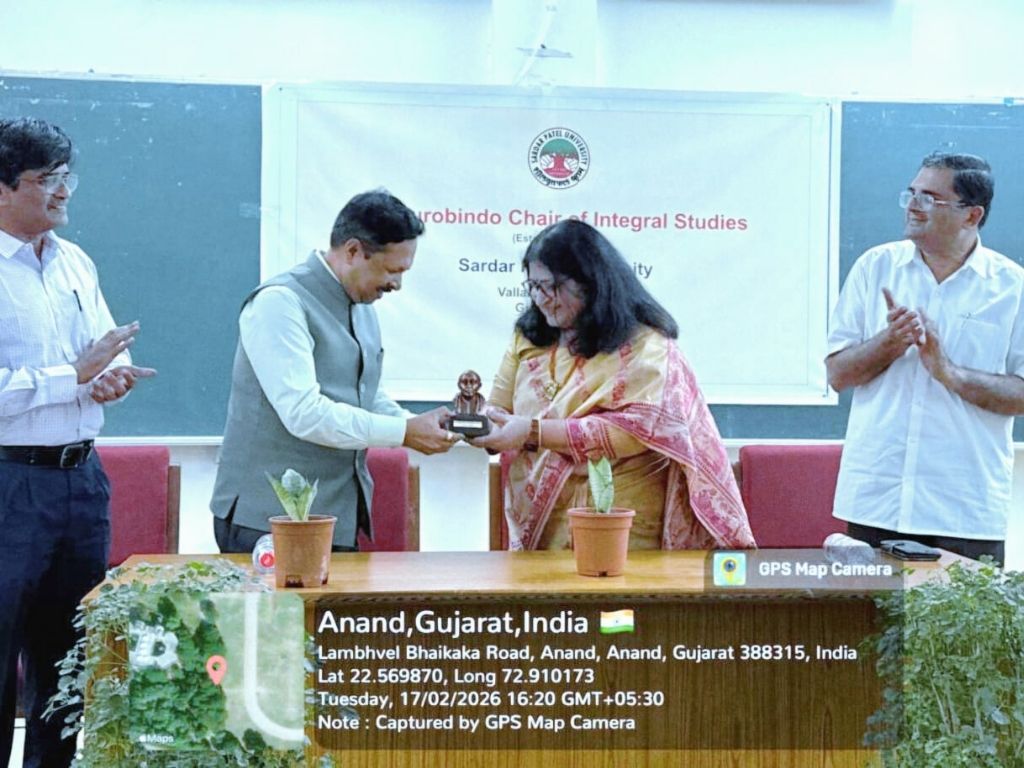
The programme came to a conclusion with a formal vote of thanks and a collective singing of Vande Mataram by all present in the hall.
WATCH
For more BhāratShakti talks, see HERE.