
Date: February 7, 2026
Venue: Matriniketan
As part of the residential programme organized by Uditam: Institute for Integral Healing, Sri Aurobindo Society, Dr. Beloo Mehra, Director, BhāratShakti, was invited to facilitate a group discussion session on Saturday, February 7, 2026. For her session, Dr. Mehra focused on the topic – Aim of Life.
Dr. Mehra started the discussion by highlighting that to live a purposeful life is to engage deeply with the fundamental insight given by the Mother that an aimless life is a miserable life and on the quality of our aim depends the quality of our life. She elaborated on this point by saying that an aimless life becomes a fragmented life. Life is inherently challenging; this cannot be avoided. But when we lack a meaningful aim, our effort becomes scattered, our motivation wanes, and we find ourselves pulled in conflicting directions.
A purposeful aim acts like a quiet inner compass. It organizes our energy, sharpens our direction, and uplifts the quality of our experiences. The quality of our life, therefore, depends less on our outer circumstances and more on the clarity of our chosen aim.
This led to some reflections by the group participants who shared their experience of how modern life often keeps us busy, but busyness is not clarity. Many of us move through our days focused on tasks and responsibilities without pausing to understand the deeper intention guiding our choices. Purpose begins with this pause—an invitation to reflect on the “why” beneath the “what” of our lives.
Dr. Mehra then added another insight for group reflection. Happiness, often assumed to be life’s ultimate goal, is unreliable. IWhat truly sustains us is progress—the sense that something within us is growing or unfolding. Progress does not require dramatic leaps; it grows from conscious forward movement. Yet this naturally leads to a deeper inquiry: Progress toward what?
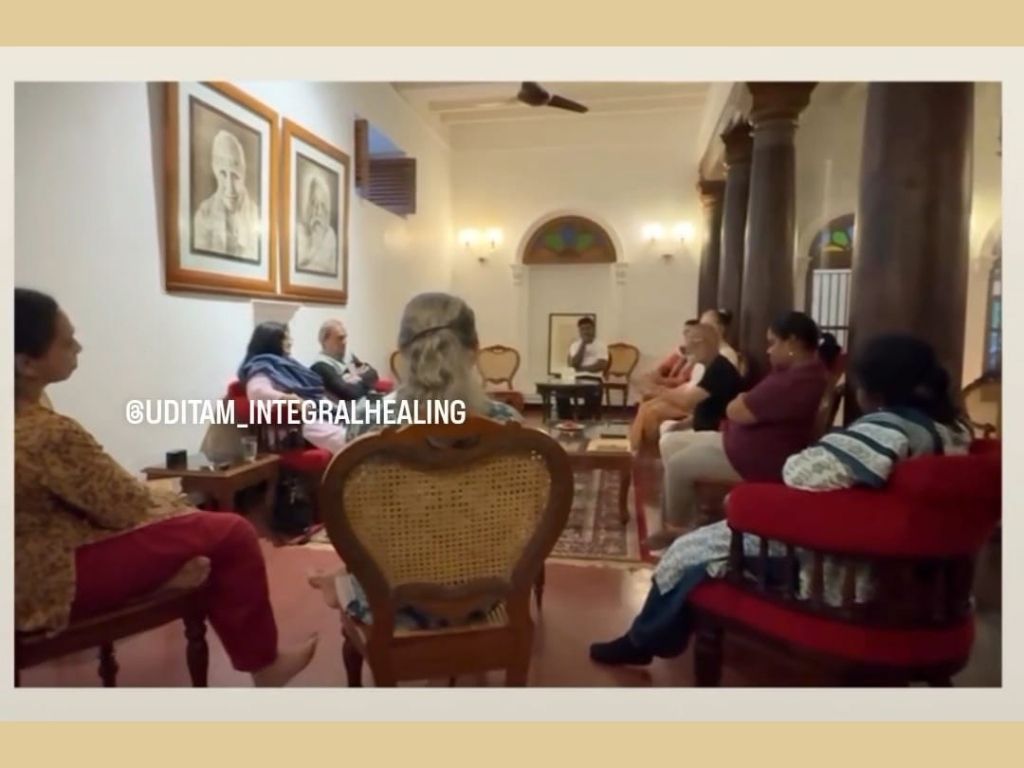
One enduring answer Indian spiritual tradition gives is that life’s purpose is to discover and serve the Divine, said Dr. Mehra. But then different people have different understanding of this word ‘Divine’. Dr. Mehra invited the participants to share their views on this. Through some sharings the group identifiied that the Divine may not be understood only as a distant external authority but as the highest ideal we can envision, the most harmonious perfection we can aspire toward, and the quiet delight (ānanda) that arises from inner alignment. In this sense, “Divine” points to our own highest possibility.
Dr. Mehra pointed out that Life, at its deepest, seeks growth in consciousness. Every experience—pleasant or painful—becomes part of this long preparation. Dr. Mehra briefly explained the concept of the evolving soul, our truest individuality beyond personality and social roles. To live purposefully is to cooperate with this inner evolution by bringing harmony to the different parts of our being: body, emotions, mind, and will. When these align around our central aspiration, inner conflict gives way to clarity.
Dr. Mehra spoke briefly of fourfold progress: growth in wisdom, strength, love and harmony, and perfection in work. Ultimately, a true aim is high, wide, generous, and not centered on ego. It must open us to something vaster than ourselves. The real transformation begins when our aim shifts from serving the ego to serving the Divine within. Walking this path requires faith, sincerity, humility, and the willingness to realign repeatedly—yet it fills life with meaning. To live purposefully is to walk forward with awareness and trust in one’s destiny and Divine’s Grace.
The session was kept interactive throughout and several valuable insights were shared by the participants. Questions concerning managing our ambitions and egoistic desires were also briefly explored.
It was also briefly discussed how for some people religion can be a stepping stone towards a genuine spiritual seeking beyond religion, and the essential purpose of religion is to turn the nature toward a Godward seeking. The session lasted for 1 hour and 45 minutes, and it was appreciated by all the participants.