
Date: January 29, 2026
Venue: Online
WATCH THE RECORDING
As a follow-up to an earlier symposium titled Antāryatra – A Spiritual Exploration of Puducherry, co-organised with Indira Gandhi National Center for the Arts, Regional Center Puducherry, BhāratShakti partnered again with IGNCA and hosted an online edition of this programme. The aim of the session was to reach a larger number of audiences through online participation and sharing of the recording.
The 2-hour-long webinar titled Antāryatra – A Spiritual Journey through Puducherry, was held on January 29, 2026. This theme is part of an important focus area of BhāratShakti’s work, namely, India-Our Mother. Under this focus area, the department also taken up works focusing on Conscious Travel.
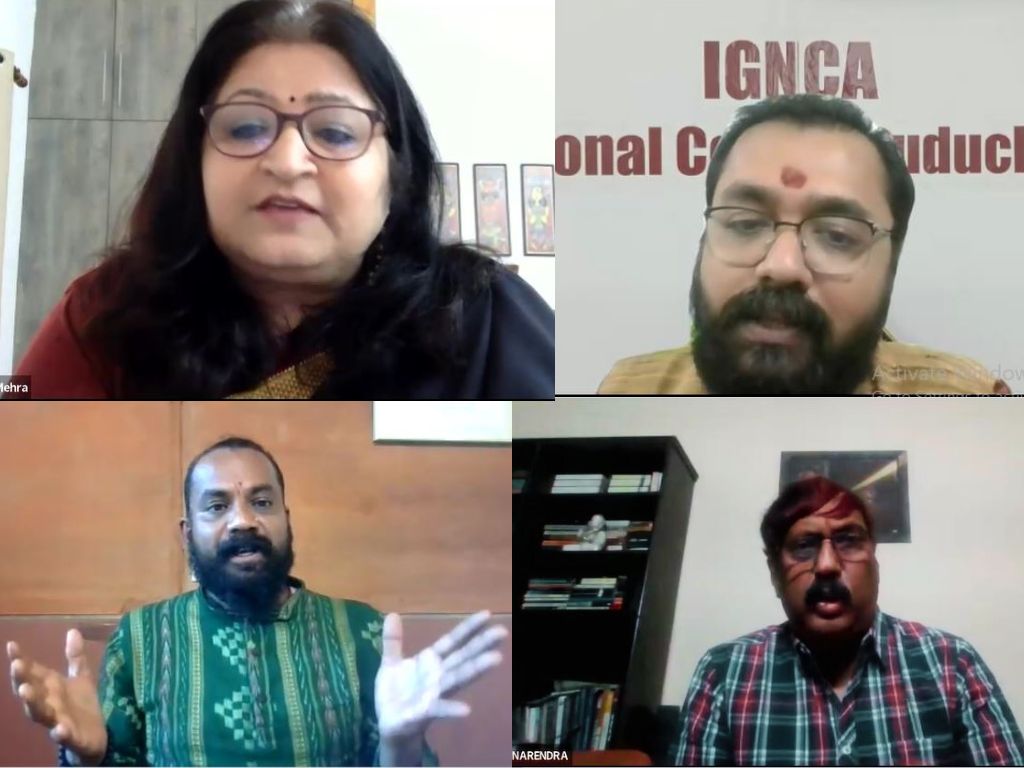
The focus of the session on January 29th was to highlight the spiritual significance of Pondicherry dating back to the Vedic times. The session was facilitated and moderated by Dr. Sumit Dey, Regional Director, IGNCA, Pondicherry.
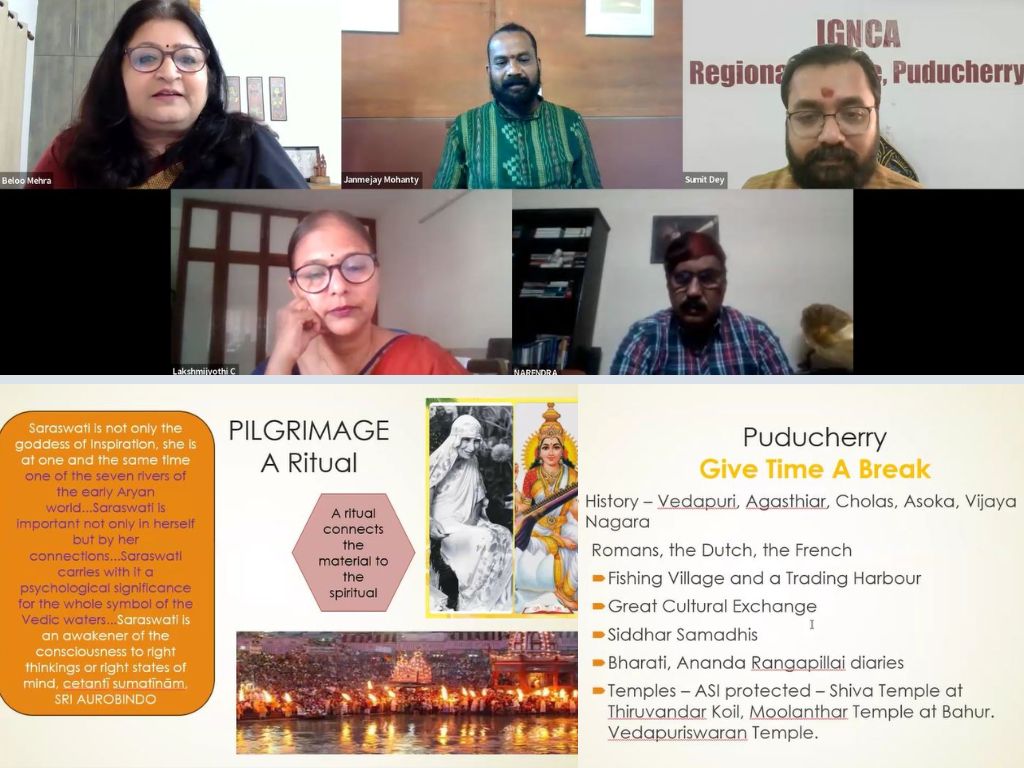
In his opening remarks Dr. Sumit Dey stated that Pondicherry has a special significance in the spiritual landscape of India since the Skanda Purana mentions that Rishi Agastya came from Varanasi to South India and it is believed that he settled here and since that time, this place was known as Vedapuri. Pondicherry also has significance because of its various temples. Then in the context of spiritual exploration he spoke about the significance of “sacred places” and “pilgrimage”. Thereafter, he invited the speakers to make their presentations.
The first talk was delivered by Dr. Beloo Mehra, Director, BhāratShakti and Editor, Renaissance. She spoke on the topic “Sri Aurobindo’s Cave of Tapasya”. She began with some details about how the arrival of Sri Aurobindo (referred to as the Uttara Yogi) was predicted by the Guru of a local zamindar and the three affirmations that would make him recognizable. They were actually the three madnesses that Sri Aurobindo wrote about in a letter to his wife in 1905:
Dr. Mehra then shared some fascinating details of how Sri Aurobindo travelled incognito from Chandan Nagore to Pondicherry in 1910 under a false name along with a companion; how the rumour was spread that one of the passengers was suffering from malaria so that they could remain isolated without attracting attention, the places where he stayed initially, how he met Subramaniya Bharati and they become friends; the financial difficulties faced by him and the political refugees like him etc.
Thereafter, Dr. Mehra spoke about how the British government tried “force, fraud and temptation” to make Sri Aurobindo leave Pondicherry but the way Sri Aurobindo resisted all of that and made the firm resolve that he was not going to leave the “seat of his Tapasya”.
She also made a reference to his divine experience during his imprisonment which guided him to choose his Cave of Tapasya. Finally, she mentioned the letter written to CR Das where he talked about the line of Sadhana he is pursuing and why he has to stay in Pondicherry for its fulfilment and the further realizations he achieved in the bringing down the Overmental and Supramental consciousness.
The subject of the talk by next speaker, Shri Janmejay Mohanty, Trustee, Bharat Nivas, Auroville was “Auroville and the Spirit of Bharat”. He shared how Bharat Nivas located in Auroville aims to offer the international community a space to experience the culture of India. The aim of Bharat Nivas is to explore new forms of art, crafts and literature. He said that the Matrimandir and Bharat Nivas represented two focal points of Auroville and they represent the soul of India.
Shri Mohanty mentioned that the different pavilions of Auroville showcase the different cultures not only of India but also of the world. He spoke briefly about some of the recent activities like Kalari classes and other cultural events being organised on a regular basis. He shared that the construction of the Crown Road in Auroville is going ahead after a long hiatus as per the vision of the Mother and is expected to be complete by this March.
Shri Mohanty said that it is important big events such as Auroville Festival which celebrate the Mother’s birthday must include participants from Sri Aurobindo Society and the Ashram and other related organisations. He also said that several visitors from outside have expressed that they do not see much of “Indianness” in Auroville; in this regard he invited all of the webinar participants and speakers to contribute in this area.
Shri Narendra Murty, Author and Research Associate, BhāratShakti then spoke on “The Temples of Pondicherry and the Significance of Temple Rituals”. He began by sharing the history of the Manakula Vinayak Temple, its speciality and some legends associated with it. Thereafter he narrated some interesting anecdotes about Ganesha, the deity of Manakula temple and his connection with the Mother and the Ashram.
He also talked about the significance of some temple rituals, highlighting that rituals are acts through which we establish our relationship with the Divine using the medium of our physical body. Every ritual in Sanatan Dharma is meaningful and has deep significance. But since this knowledge has been lost over centuries, now we are just following them mechanically without knowing the meaning and that is why the younger generation are not able to relate to them and are reluctant to perform them.
Shri Murty briefly explained the meaning of “Namaste” and “Shastanga Pranam.” Speaking about the layout of temples in India, he said that almost every temple has some design elements in common: the outer walls of the temple, the inner corridor and the Garbha Griha (sanctum sanctorum). He explained the meaning of some temple rituals like Pradakshina, offering of fruits and coconut and receiving the Prasad. He closed his talk by saying that the outer pilgrimage is a mirror image of an inner process of spiritual sadhana. Just as pilgrimage in the outer world involved travelling for months culminating finally with the Darshan of the deity so too the inner pilgrimage involved years of inner striving leading to the realization of the Divine (Darshan).
Ms. Lakshmijyothi C., Founder, AuroIndian (a travel consulting venture in Pondicherry), spoke on the topic “Experiencing Puducherry Beyond the Obvious”. She began her presentation by briefly examining the concept of Conscious Travel which involves knowing the Intangible Cultural Heritage of a particular place – not just the well-known landmarks and monuments. And that consists of Oral Traditions and expressions, Performing Arts, Festivals and Rituals, Knowledge and Practices and Traditional Craftsmanship.
She said that our endeavour should be to convey to the visitors this Intangible Cultural Heritage so that the visitors to a place take something mentally and spiritually and feel elevated and enriched. For instance, in Pondicherry how do we convey to outsiders the inner significance of the Vinayaka temple or the Sri Aurobindo Ashram or Auroville? The biggest challenge that confronts those engaged in travel and tourism related professions is the commodification of culture and the pressure to adapt traditional practices for tourist consumption.
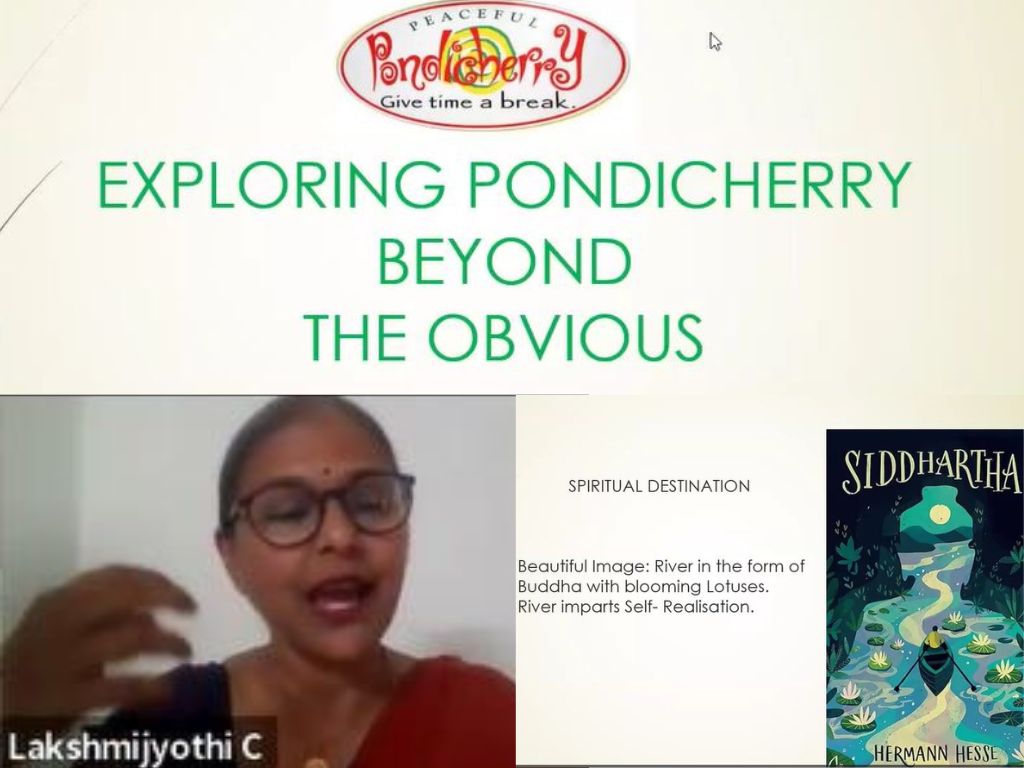
Ms. Lakshmijyothi shared a few quotes from Sri Aurobindo pertaining to developing a deeper cultural awareness; the most important point being that both the spirit and forms must be experienced to acquire a total vision. She also spoke about the significance of Pilgrimage and Rituals and how certain places have a certain spiritual force behind the geographical reality. She briefly touched upon the history of Pondicherry and its spiritual significance and wondered how we could sensitise people about it. She concluded her presentation by briefly speaking about AuroIndian that she founded and its mission to promote “spiritual and conscious tourism”.
A short interactive session followed based on the questions of the participants. The final summing up of the webinar was done by Dr. Sumit Dey.