
Date: January 11, 2026
Venue: Sri Aurobindo Society
As part of the Annual All-India Youth Camp 2026 organised by AuroYouth, Sri Aurobindo Society, Dr. Beloo Mehra, Director, BhāratShakti, was invited to conduct a session with the participants. The 1.5-hour-long session on January 11, 2025 focused on the topic ‘On Money and Work’.
Dr. Mehra’s presentation explored the deeper philosophical and spiritual perspectives on money and work, drawing extensively from Sri Aurobindo and The Mother’s writings. It emphasized the need to rethink conventional attitudes toward these aspects of life and integrate them into a higher purpose.
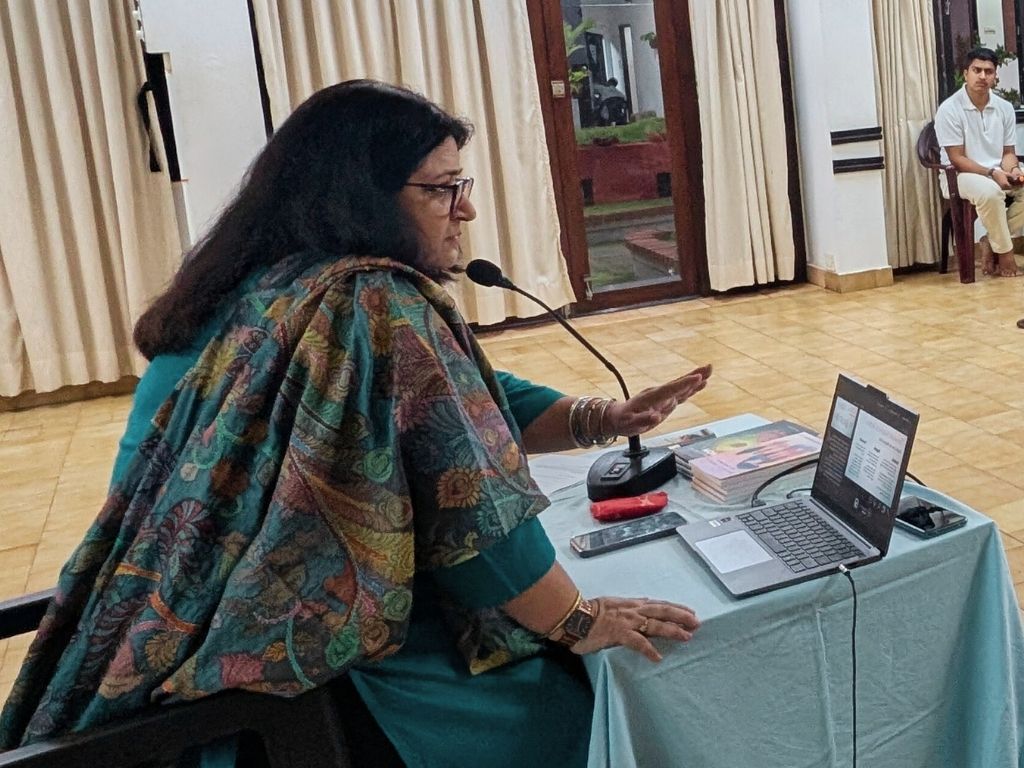
It was emphasised that Sri Aurobindo envisioned Yoga emerging from its secluded retreats to become a dynamic force shaping the future of humanity. This implies that spiritual principles must find expression in practical domains like work and economics, contributing to the sum of living human powers and utilities.
The real value of work – all works including business depends on the spirit, principle, and purpose behind it, Dr. Mehra emphasised. She gave some examples highlighting that even activities like politics and war, though not spiritually pure, were undertaken by Sri Aurobindo when aligned with a higher aim. The focus is on transforming the motive and consciousness behind action rather than rejecting worldly engagement.
Dr. Mehra explained that Indian thought recognises that the egoistic phase of evolution is a necessary stage in an individual’s progress. Ego serves as a helper, enabling individuality and self-assertion before one can transcend to the soul-consciousness. This phase fosters the development of human capacities for mastery and self-discrimination, which later become instruments for spiritual growth.
For a sufficiently long phase, human life initially revolves around artha (self-interest) and kāma (desire), satisfying the natural ego’s needs. These motives are not to be suppressed but gradually refined; this has been the timeless wisdom in Indian spiritual thought. Work, in this view, becomes a field of practice to perfect outer instruments and express inner truth. It tests the nature, revealing defects that might otherwise remain hidden.
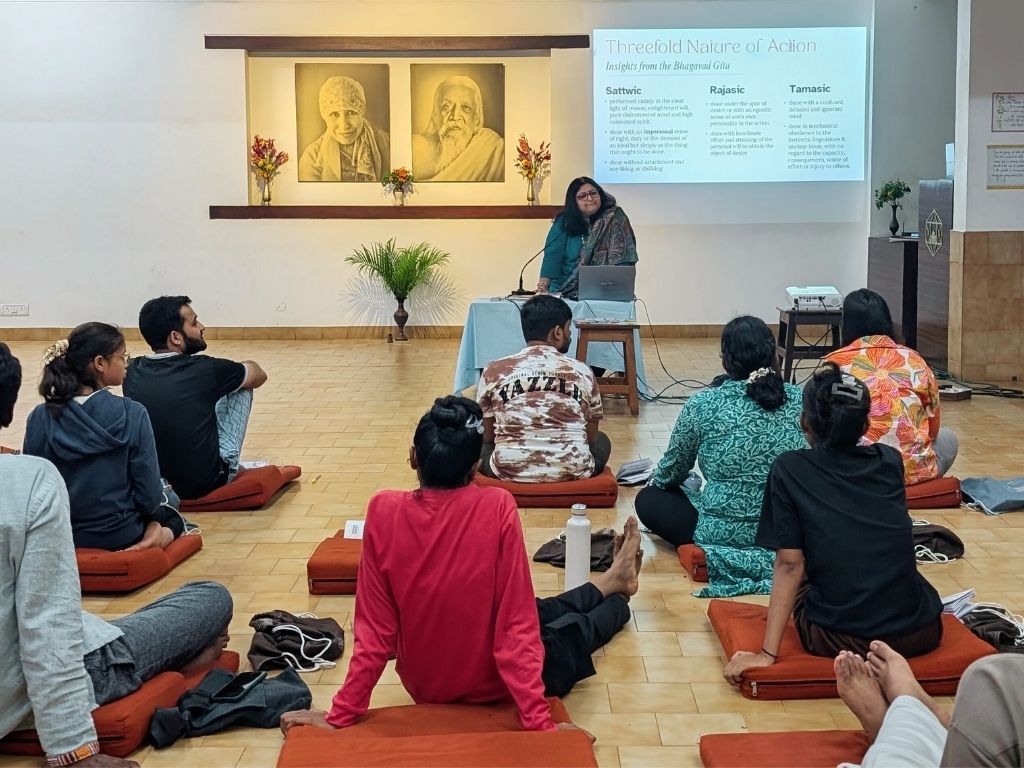
Drawing from the Bhagavad Gita, Dr. Mehra explained the threefold nature of action, using some practical examples.
- Sāttwic: Calm, reasoned, disinterested, and free from attachment.
- Rājasic: Driven by desire, ego, and passionate effort for results.
- Tāmasic: Ignorant, mechanical, and careless of consequences. The sāttwic doer works with impersonal resolve and enthusiasm, while the rājasic and tāmasic modes lead to bondage and inefficiency.
It was also highlighted that true progress comes when work is done:
- Without desire or attachment to reward.
- Free from egoistic motives.
- As an offering to the Divine. Perfection in execution matters more than scale or scope. Silence and humility in action are emphasized as marks of inner discipline.
Dr. Mehra said that from an Integral Yoga perspective, money must be understood as a visible sign of a universal force, indispensable for the fullness of outer life. The right attitude towards money involves neither an ascetic rejection nor a rajasic attachment. Instead, money should be used as a trustee for accomplishing works for the divine and in a spirit that is free of all instinct of possessiveness. Misuse of money force leads to “economic barbarism,” where life becomes a pursuit of accumulation, luxury, and vulgarized values—hallmarks of commercialism.
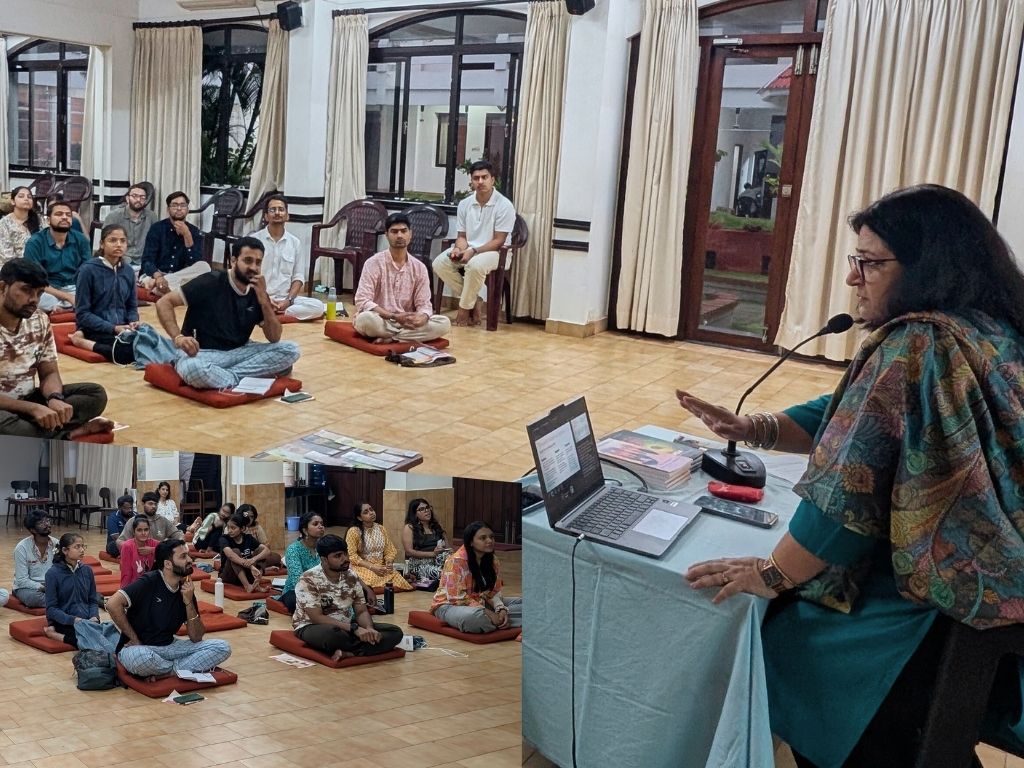
Ultimately, money and work are meant to prepare the earth for a new creation. When rightly approached, they become instruments for spiritual evolution and collective progress. The Mother’s vision calls for abundance in service of good works, not personal indulgence. In essence, the session highlighted the need for a deep shift in our attitude with work and wealth—shifting from ego-driven motives to a spirit of offering, trusteeship, and integral growth.
Click HERE to watch 3 short videos on ‘Cultivating the Right Attitude Towards Money’